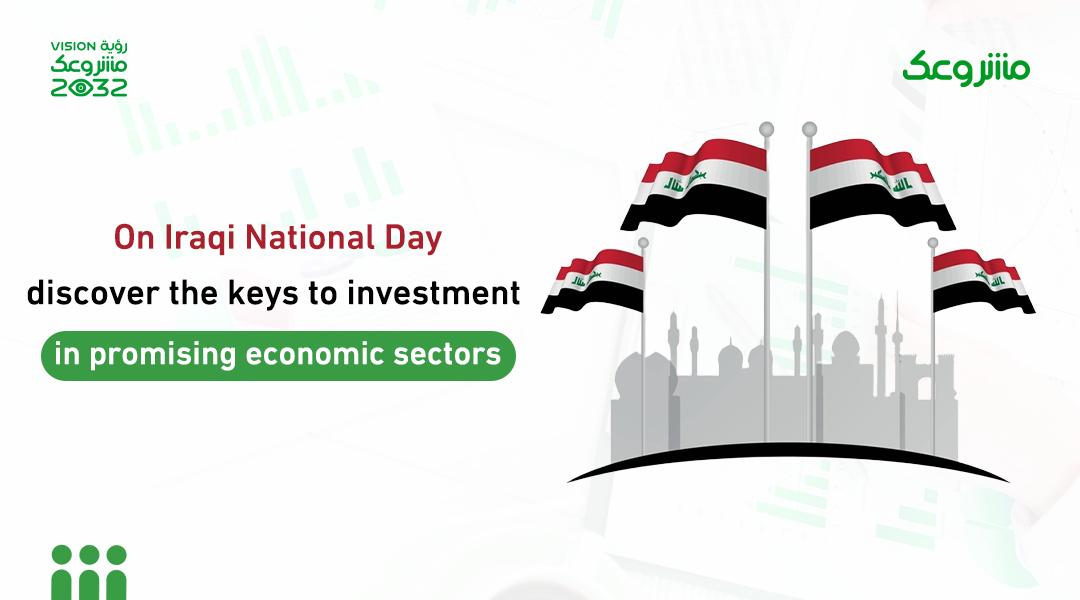
Iraq’s National Day: A Great Occasion to Celebrate the Nation and Its Economic Potential
Iraq’s National Day is a momentous occasion deeply rooted in the hearts of its people. Every year, Iraqis come together to commemorate a defining historical milestone that shaped the nation’s identity and reinforced the principles of unity and belonging. The celebration goes beyond its symbolic and emotional significance—it also serves as a vital platform to highlight Iraq’s vast economic and investment potential, positioning the country as a leading destination for both regional and international capital.
With its abundant natural resources, strategic geographic location, and young, dynamic workforce, Iraq stands today at the threshold of a new era of construction and development. Thus, the National Day takes on a dual meaning: it honors a proud past while looking ahead to a prosperous economic future. It is not merely a day of celebration—it is an opportunity to spotlight the promising sectors, investment opportunities, and development initiatives that are restoring Iraq’s rightful place on the global economic map.
Iraq’s National Day is an annual celebration marking the country’s independence and accession to the League of Nations as a fully sovereign state—possessing its own laws, resources, and a well-structured government capable of managing public affairs.
Although the idea of designating this date as a national holiday was proposed in 2008, it was officially enacted in September 2020, when the Iraqi government declared it a fixed national holiday. Since then, this day has become a prominent national event that revives the memory of Iraq’s modern history and renews citizens’ pride in unity and sovereignty. It reflects the diversity and cohesion of the Iraqi people under one flag, inspiring new generations with pride, belonging, and a shared vision for building the nation’s future.
Iraq’s National Day falls on October 3rd of each year—the day Iraq declared its independence from the British mandate in 1932, becoming the first Arab country to join the League of Nations. Since then, the date has stood as a defining moment in the nation’s history, marked by official and popular celebrations that embody Iraq’s pride, heritage, and aspirations for the future.
On Iraq’s National Day, the celebration is not limited to reflecting on the nation’s glorious past—it is also an opportunity to renew commitment to Iraq Vision 2030, which is built upon five strategic pillars:
Among these, the economic pillar represents the cornerstone that supports the achievement of all other goals, as a strong and diversified economy is the true guarantor of social welfare and national stability.
For decades, Iraq’s economy suffered from dual dependence—on oil revenues and on the dominance of the public sector in generating income and employment. To overcome this, Iraq Vision 2030 sets a bold path toward building a diversified economy capable of creating decent jobs and improving living standards for all Iraqis through a balanced and effective partnership between the public and private sectors.
On this National Day, Iraq reaffirms its determination to turn this vision into reality—because a strong, diversified economy is the foundation of a prosperous and stable modern state.
Investing in Iraq offers numerous advantages, including:
The industrial sector is one of Iraq’s main pillars for economic diversification and future growth. According to recent data:
According to the World Bank (2023), Iraq’s manufacturing value added reached IQD 11.78 trillion (current prices)—a clear indicator of the sector’s strong potential.
Industrial output’s contribution to GDP has risen from 2% in 2021 to 4% by the end of 2023, signaling steady progress toward economic diversification away from oil dependency.
The number of factories is growing at an average annual rate of 8.9%, reflecting a strengthening investment climate and growing confidence among entrepreneurs and investors.
According to Mashroo3k Consulting, Iraq’s industrial sector holds immense potential to become an attractive investment destination, particularly with the government’s strategic commitment to boosting industrial output and supporting national industries.
The agricultural sector is another cornerstone of Iraq’s economy—not only for its historical significance as the cradle of ancient civilizations, but also for its crucial role in achieving food security, supporting rural development, and creating jobs. It also contributes to improving the balance of payments by reducing import dependence and increasing agricultural exports.
This sector presents vast investment opportunities, thanks to fertile land, available water resources, skilled labor, and growing government support aimed at modernizing agricultural value chains and boosting domestic production.
Key indicators highlighting Iraq’s agricultural potential include:
Would you like me to continue with the translation of the remaining sections (e.g., energy, tourism, or services sectors) in the same polished and professional style?
The following table presents the main agricultural crops and their production levels in Iraq:
| Crop | Cultivated Area (dunams) | Production Volume (tons) |
|---|---|---|
| Wheat | 7,487,196 | 2,764,692 |
| Barley | 2,308,670 | 144,493 |
| Rice | 384,926 | 422,463 |
| Sunflower | 2,381 | 1,183 |
| Yellow Corn | 334,358 | 496,003 |
| Potatoes | 50,580 | 270,591 |
| Okra | 50,000 | 93,400 |
| Tomatoes | 131,000 | 744,200 |
| Green Cowpeas | 17,600 | 26,600 |
| Watermelon | 63,100 | 205,200 |
| Green Onions | 21,900 | 60,400 |
| Eggplant | 51,100 | 215,700 |
| Green Pepper | 21,600 | 58,800 |
| Cucumber | 84,200 | 185,500 |
The education sector is a fundamental pillar in building societies and developing human resources. It is considered a national priority in Iraq due to its vital role in shaping the future of generations and driving the wheel of development. Despite the challenges it has faced over the decades, the sector is currently witnessing continuous efforts to expand educational infrastructure, enhance the quality of education, and increase enrollment rates across all educational stages. The following indicators reflect the current state of education in Iraq:
The healthcare sector is one of the main pillars of quality of life and sustainable development. For this reason, the Iraqi government places increasing emphasis on its development by raising public funding, enhancing healthcare infrastructure, and improving the quality of medical services provided to citizens. The government is also working to encourage investment in this vital sector by facilitating the establishment of healthcare facilities, offering tax incentives and financial exemptions for investors, and easing the import of modern medical equipment and technologies.
In celebration of Iraq’s National Day, Mashroo3k Consulting presents to decision-makers and investors Healthcare Infrastructure
Number of public medical clinics: 358 clinics interested in entering this field the most important statistical indicators that provide a realistic picture of the healthcare sector in Iraq:
Number of hospitals: 482 hospitals
Number of other healthcare institutions (including health centers, laboratories, and others): 4,084 institutions
The tourism sector in Iraq is considered one of the promising sectors with significant potential, due to the country’s rich ancient heritage, archaeological and historical sites that date back thousands of years, as well as its diverse geography, natural landscapes, and numerous religious landmarks that attract millions of visitors annually. Despite the challenges the sector has faced over past decades, Iraq is currently witnessing increased governmental efforts to stimulate tourism, develop infrastructure, facilitate entry procedures, and encourage investment in this vital field, recognizing it as a key contributor to economic development and the diversification of national income sources.
The hotels are categorized according to their star ratings as follows:
| Star Rating | Number of Hotels |
|---|---|
| 5 stars | 35 |
| 4 stars | 129 |
| 3 stars | 403 |
| 2 stars | 455 |
| 1 star | 545 |
| Popular / Unrated | 724 |
The food sector is considered one of the vital sectors in Iraq due to its direct link to meeting the population’s needs and its wide investment opportunities in manufacturing, packaging, storage, and distribution. This is especially significant given the heavy reliance on imports and the untapped potential within the sector. On the occasion of Iraq’s National Day, Mashroo3k Consulting presents key statistical indicators that provide a realistic overview of the sector:

To communicate and learn more about Mashroo3k company and its services
The kebab restaurant project is one of the food-service ventures that combines strong demand for grilled meals with the opportunity to target a diverse customer base, including individuals, families, and lovers of traditional Middle Eastern cuisine. With growing competition in the restaurant sector, however, the project’s success is no longer determined by food taste alone. […]
Read moreA children’s toy store project is not limited to selling toys; it is built on understanding what attracts children and what families look for when choosing products that combine entertainment and educational value. With the wide variety of educational toys, skill-development games, recreational toys, and gifts available, the store has opportunities to meet the needs […]
Read moreA residential complex project is no longer simply an investment in a collection of real estate units. It has evolved into an integrated development model that combines comfortable living, diverse services, and long-term investment value. As cities expand and residents’ needs evolve, demand is growing for residential complexes that offer a comprehensive environment suited to […]
Read moreThe veterinary clinic project comes at a time when animal care is no longer limited to treating illnesses or injuries, but has expanded to include health monitoring, vaccinations, routine checkups, and care for both pets and livestock. However, many animal owners face challenges in accessing specialized veterinary services that combine prompt response, high-quality care, and […]
Read more
خصم 25% على خدمات مشروعك استفد من العرض الآن، فالفرصة متاحة لفترة محدودة فقط
سجّل بياناتك واحصل على خصم 25% الآن


