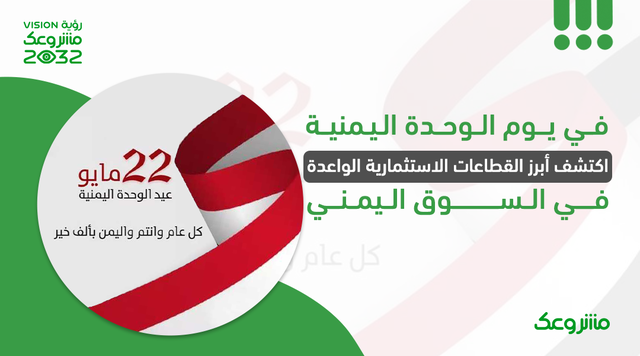
The Yemeni Unity Day represents a historic milestone that embodies the aspirations of the Yemeni people toward stability and economic and social development. As we commemorate this cherished national occasion, the discussion about investment opportunities in Yemen emerges as an important step toward building a more prosperous future.
Despite the existing challenges, the Yemeni market is rich with promising sectors that possess strong growth potential, ranging from agriculture and industry to healthcare, tourism, education, construction, and many others. In this article, we take you on an exploratory journey through the most prominent of these sectors, supported by indicators and data that can serve as a genuine starting point for local and international investors seeking to contribute to rebuilding Yemen and supporting its economic revival.
Yemeni Unity Day falls on May 22 of every year. It is a historic national occasion celebrated by the Yemeni people to commemorate the official proclamation of the Republic of Yemen in 1990.
On this day, the Yemen Arab Republic in the north merged with the People’s Democratic Republic of Yemen in the south under one state. The capital was established in Sana’a as the political capital, while Aden became the economic capital. This unification marked the end of a long period of geographical and political division shaped by British colonial rule in the south and the Imamate system in the north, opening a new era of national unity and shared destiny.
Unity reflected the aspirations of Yemenis for a unified national identity and was seen as a foundation for building a stronger and more stable state. However, this vision faced significant challenges in its early years, including political tensions that escalated into the 1994 civil war and later separatist movements that affected the concept of unity itself.
Despite these challenges, May 22 remains a deeply rooted national symbol in Yemen. It represents the dream of a unified state and holds an important place in the national calendar as one of the country’s official holidays.
Yemeni Unity Day represents a pivotal historical milestone in the consciousness of the Yemeni people. It is not only a political event that led to the unification of North and South Yemen, but also a foundational pillar in building a comprehensive national identity that transcends regional, sectarian, and tribal affiliations. Its importance can be highlighted in several key aspects:
On the anniversary of Yemeni Unity Day, hopes are renewed for a more stable and economically prosperous future. This national occasion becomes a valuable opportunity to highlight the real investment advantages Yemen holds, making it a promising destination for investors from all directions.
Yemen possesses a rich diversity of natural resources and strong economic potential that—if a stable environment is achieved—can position the country as an attractive regional investment hub capable of accommodating various sectors and opening wide opportunities for both local and international investors.
| Project Type | Cost | Exemptions and Benefits |
|---|---|---|
| Small & Micro Projects | ≤ 100,000 USD | – 100% exemption from customs and taxes on fixed assets and production inputs – Free use of government land for the entire operating period |
| Medium Projects | 100,000 – 1,000,000 USD | – 100% exemption on fixed assets and spare parts – 75% exemption on customs duties for production inputs – Income tax exemption for 7 years from the start of actual production |
For more information about the advantages of investing in Yemen, click here.
On the occasion of Yemeni Unity Day, we highlight the most prominent investment sectors experiencing noticeable growth in Yemen. These sectors now represent strategic and promising opportunities that cannot be overlooked, whether for local investors seeking to expand and diversify their economic portfolios, or for international investors looking to enter new markets rich in untapped potential and opportunities that await effective utilization.
Below are the key sectors:
The industrial sector represents one of the most important key drivers of economic development in any country, and Yemen is no exception. The country possesses abundant natural and human resources, in addition to a strategic geographical location that makes it well-positioned to build a strong industrial base capable of contributing to comprehensive development.
Yemen’s location at the crossroads of international trade routes between Asia, Africa, and Europe, overlooking the Gulf of Aden and the Arabian Sea, gives it a natural advantage for developing a dynamic and competitive industrial economy.
Investment in the industrial sector is particularly important in the Yemeni context, as it creates job opportunities that help reduce rising unemployment, decreases reliance on imports by strengthening local production, and contributes to increasing national exports and diversifying income sources. In the context of reconstruction and economic recovery efforts, the industrial sector becomes a vital pillar for achieving a more self-sufficient and sustainable Yemen.
According to the latest industrial survey conducted by the state, the industrial sector indicators in Yemen are as follows:
| Category | Number of Establishments | Number of Workers | Total Compensation (Million Riyals) |
|---|---|---|---|
| Very large establishments | 360 | 41,240 | 35,011 |
| Large establishments | 969 | 14,198 | 2,627 |
| Medium establishments | 4,617 | 29,488 | 10,591 |
| Small establishments | 40,694 | 75,500 | 24,260 |
| Total | 46,640 | 160,425 | 72,488 |
Please read here: Successful project ideas to promote development and prosperity in Yemen.. Discover them now.
The agricultural sector is considered one of the most closely linked sectors to people’s daily lives in Yemen, as it employs a large share of the total workforce and contributes significantly to the country’s GDP. Yemen is distinguished by exceptional climatic and geographical diversity, ranging from coastal plains and highlands to desert areas. This diversity allows for the cultivation of a wide range of crops that are not commonly found together in many countries.
These include the world-renowned Yemeni coffee, cereals such as maize, wheat, and millet, as well as fruits, vegetables, and date palms. In addition, Yemeni honey holds a prestigious position in international markets due to its high quality and unique characteristics.
Beyond crop production, Yemen also possesses rich livestock and fishery resources, which further enhance the sector’s potential and expand its scope. This makes agriculture a fundamental pillar of economic development and food security, as well as a promising investment destination with vast untapped opportunities.
According to available data:
Below are the main crops:
| Crop Type | Cultivated Area (hectares) |
|---|---|
| Wheat | 15,863 |
| Other cereals (maize, millet, barley, sorghum) | 140,863 |
| Legumes | 372 |
| Vegetables | 20,937 |
| Fodder crops | 58,194.4 |
| Cash crops | 16,863 |
| Fruit | 44,877 |
| Qat | 20,439 |
Read here: Discover the top 7 profitable agricultural projects.
| Type | Number (thousand heads) |
|---|---|
| Sheep (Sheep / Lambs) | 3,424 |
| Goats | 4,069 |
| Cows | 320 |
| Camels | 265 |
Read here: Learn how to implement a profitable sheep farming project.
Read here: How to start a fish farming project.
The construction sector is one of the most vital and important sectors in Yemen’s current economic landscape, particularly in light of the urgent need for reconstruction and rebuilding what years of conflict have damaged in infrastructure, housing, and public facilities.
This sector has strong potential for growth, primarily due to the availability of local raw materials such as stone, sand, gypsum, and cement, in addition to a high population density that generates continuously increasing demand for housing units and service projects.
The sector extends to include the construction of roads, bridges, hospitals, schools, and water and electricity stations—projects that have become an urgent necessity that cannot be delayed. The major investment opportunity in this sector lies in the gap between the massive level of demand and the currently limited local production capacity, which opens the door wide for both local and international investors to participate in reconstruction projects and the building of a new Yemen.
| Category | Value |
|---|---|
| Road projects | 359 |
| Electricity projects | 8 |
| Oil projects | 3 |
| Water and sewage projects | 97 |
| Health projects | 53 |
| Public buildings projects | 26 |
| Schools and institutes projects | 166 |
| Number of issued licenses | 3,033 |
| New construction licenses | 2,172 |
| Building addition licenses | 489 |
| Building modification licenses | 48 |
| Renovation licenses | 121 |
| Fence licenses | 189 |
| Total area (m²) | 3,987,908.60 |
| Built-up area (m²) | 884,031.08 |
| Residential houses | 1,722 |
| Residential buildings | 926 |
| Commercial buildings | 87 |
Read here: All the secrets to profiting from a building materials store project.
The education sector is considered one of the highest national priorities in Yemen and one of the most impactful sectors in the country’s comprehensive development path. It represents the fundamental pillar for building the Yemeni individual capable of advancing the nation and leading recovery and reconstruction efforts.
Despite the severe impacts left by years of conflict—such as damage to many schools and universities, declining enrollment rates, and increasing dropout rates—the sector still holds strong potential for revival. This is largely supported by a large youth population, which represents the majority of Yemeni society.
Investment opportunities in this sector are diverse and include the establishment of private schools and universities, the development of vocational and technical training centers that prepare qualified cadres for the labor market, as well as investment in e-learning and digital platforms, which are becoming the future of education worldwide.
Investing in education in Yemen today is not only an economically viable opportunity but also a humanitarian and national mission that contributes to rebuilding people before infrastructure.
| Element | Public kindergartens | Private kindergartens |
| Number of kindergartens | 116 | 147 |
| Number of students | 15,670 | 9,153 |
| Number of study groups | 413 | 449 |
Read here: Practical steps to establish a daycare project
| Element | Government secondary schools | Private secondary schools |
| Number of schools | 1,704 | 65 |
| Number of students | 770,221 | 125,742 |
| Number of classrooms (study sections) | 23,230 | 2,556 |
| Number of teachers | 29,062 | 3,728 |
Read here: The complete guide to establishing a private school project from A to Z
| Element | Government secondary schools | Private secondary schools |
| Number of schools | 119 | 14 |
| Number of students | 143,667 | 16,339 |
| Number of classrooms (study sections) | 2,505 | 204 |
| Number of teachers | 6,801 | 915 |
The healthcare sector in Yemen is considered one of the most in-need areas for investment and development, given the immense pressure placed on the health system due to years of conflict. These conditions have led to significant damage to many hospitals and health centers and a noticeable decline in the quality of services provided.
Health indicators reveal a substantial gap between the growing needs of the population and the actual available services on the ground. This makes the sector a fertile environment for promising investment opportunities, including the establishment of hospitals and specialized clinics, the supply of modern medical equipment and devices, and the creation of pharmaceutical and medical supply factories—especially since Yemen relies heavily on imports for most of its medical needs.
In addition, there is a strong need to develop training centers for medical and nursing staff, as well as invest in telemedicine technologies that can deliver healthcare services to remote areas suffering from limited access.
Investing in Yemen’s healthcare sector remains one of the most impactful forms of investment, combining strong economic returns with profound humanitarian value that directly affects the lives of millions.
Please read here: Hospital Project.. A Golden Opportunity in the Growing Healthcare Sector
Yemenis celebrate Unity Day on May 22 of each year to commemorate the declaration of the Republic of Yemen in 1990, when the long-awaited dream of unifying North Yemen and South Yemen under one state was achieved after decades of division.
This day carries deep significance that goes beyond the political dimension, as it represents the culmination of a long struggle by the Yemeni people to achieve unity and shared destiny. It also reinforces a unified national identity that transcends regional and tribal affiliations.
In light of the country’s ongoing challenges, this occasion gains even greater importance, serving as a renewal of commitment to national unity and a call to draw strength from the spirit of cohesion in overcoming obstacles to development and stability.
Yemen Unity Day falls on May 22 each year. It marks the official announcement of the Republic of Yemen in 1990, following the unification of the Yemen Arab Republic in the north and the People’s Democratic Republic of Yemen in the south. It is considered one of the most important official national holidays in Yemen.
It is Yemen’s Revolution Day, celebrated annually to mark the September 26, 1962 revolution that overthrew the Imamate monarchy in North Yemen and established the Yemen Arab Republic. This revolution is considered a turning point in modern Yemeni history, ending centuries of monarchical rule and ushering in a new republican era based on freedom and equality.
November 30 is Yemen’s National Independence Day, commemorating the independence of South Yemen from British colonial rule in 1967. On this day, British forces withdrew from Aden, marking the end of colonial presence and the beginning of a new era of national sovereignty and independence.
November 30 is Yemen’s National Independence Day, celebrated annually to commemorate the independence of South Yemen from British colonial rule on November 30, 1967. On this day, British forces withdrew from Aden, and the Republic of South Yemen was declared, later known as the People’s Democratic Republic of Yemen.
This independence came as the result of a long armed struggle led by Yemeni national movements against British presence, which had lasted for more than 130 years since the occupation of Aden in 1839. This day holds a deeply rooted historical significance in the memory of Yemenis as a symbol of national liberation and the restoration of sovereignty.

To communicate and learn more about Mashroo3k company and its services
The kebab restaurant project is one of the food-service ventures that combines strong demand for grilled meals with the opportunity to target a diverse customer base, including individuals, families, and lovers of traditional Middle Eastern cuisine. With growing competition in the restaurant sector, however, the project’s success is no longer determined by food taste alone. […]
Read moreA children’s toy store project is not limited to selling toys; it is built on understanding what attracts children and what families look for when choosing products that combine entertainment and educational value. With the wide variety of educational toys, skill-development games, recreational toys, and gifts available, the store has opportunities to meet the needs […]
Read moreA residential complex project is no longer simply an investment in a collection of real estate units. It has evolved into an integrated development model that combines comfortable living, diverse services, and long-term investment value. As cities expand and residents’ needs evolve, demand is growing for residential complexes that offer a comprehensive environment suited to […]
Read moreThe veterinary clinic project comes at a time when animal care is no longer limited to treating illnesses or injuries, but has expanded to include health monitoring, vaccinations, routine checkups, and care for both pets and livestock. However, many animal owners face challenges in accessing specialized veterinary services that combine prompt response, high-quality care, and […]
Read more
خصم 25% على خدمات مشروعك استفد من العرض الآن، فالفرصة متاحة لفترة محدودة فقط
سجّل بياناتك واحصل على خصم 25% الآن


