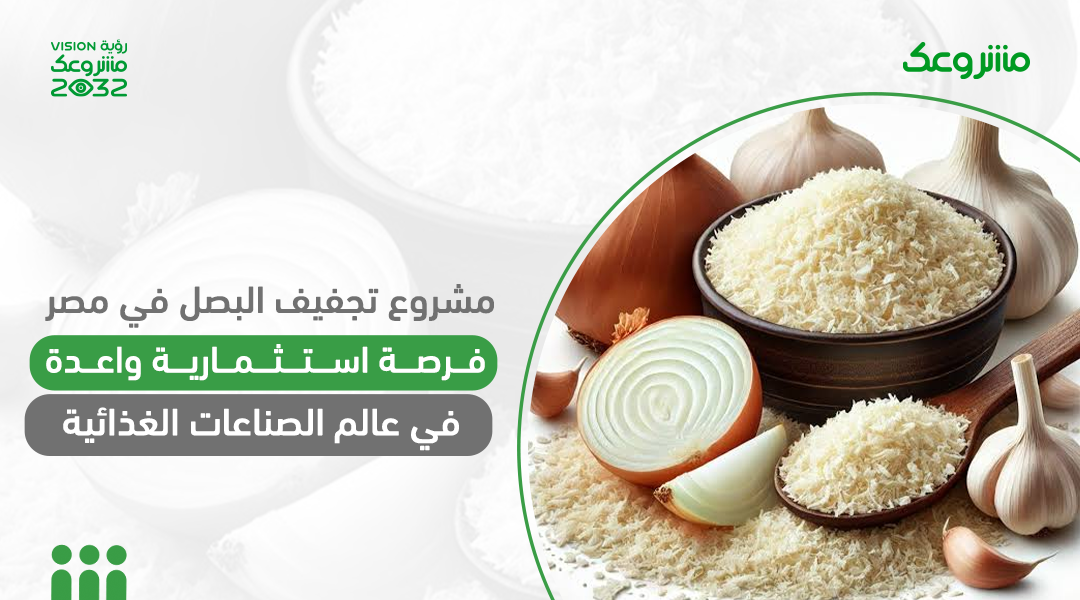
The onion drying project is considered one of the promising food processing ventures experiencing growing demand in local and global markets, as many food factories, restaurants, and packaging companies rely on dried onions as one of the essential ingredients in their products. This project offers the potential to generate attractive returns by utilizing agricultural crops and converting them into value-added products with a longer shelf life. With growing interest in the food processing industry and the expansion of export activities, an onion drying project has become an attractive investment opportunity for investors and entrepreneurs seeking a business that combines stability with growth. In this context, we explore the importance of the project, its key requirements, production stages, and the main success factors that contribute to achieving the best results in this field.
An onion drying project is a food processing business that involves treating fresh onions by removing a significant portion of their water content using specialized drying techniques. The aim is to produce dried onions with a longer shelf life and greater ease of transportation and handling.
Dried onions are widely used in the food processing industry, ready-made food factories, spice companies, restaurants, and hotels, making them a product with consistent market demand. The project aims to increase the added value of the onion crop and reduce losses resulting from spoilage or seasonal price fluctuations. The process involves preparing, sorting, and slicing the onions, followed by drying and packaging them according to the required quality standards. The project is considered a promising investment opportunity due to its diverse marketing channels and potential for expansion into both local and export markets.
Read here: Fruit Drying Project: Concept, Benefits, and Production Stages
Yes, the onion drying project is considered one of the most profitable investment ventures. Global estimates indicate thatthe dried onion market was valued at approximately USD 10.91 billion in 2024, with expectations for continued growth to reach USD 11.51 billion in 2025, before gradually increasing to approximately USD 19.72 billion by 2035. This reflects significant and sustained expansion in this vital sector. The market is also expected to record a compound annual growth rate (CAGR) of approximately 5.53% during the period from 2025 to 2035.
Read Here: Best Successful Small Projects for Youth in 2026
An onion drying project is considered a promising industrial venture due to the many investment advantages it offers, making it an attractive option for investors. The most notable advantages include:
The cost of an onion drying project includes several key components, most notably:
Read here: Vegetable and Fruit Drying Project in Saudi Arabia: Steps to Success from Establishment to Marketing
An onion drying project requires a range of equipment and machinery to ensure that the production process runs efficiently. The most important include:
The success of an onion drying project depends on several key factors that ensure production quality and sustained demand. The most important include:
Read here: How to Achieve Financial Success by Investing in Successful Small Projects
| Challenges | How to Overcome Them |
|---|---|
| Fluctuations in Raw Onion Prices | Entering into contracts with reliable suppliers and storing quantities during periods of lower prices. |
| Poor Quality of the Onions Used | Establishing strict sorting standards and selecting high-quality raw materials. |
| High Energy Consumption | Using energy-efficient equipment or improving operational efficiency. |
| Equipment Breakdowns | Conducting regular maintenance and keeping spare parts available. |
| Weak Marketing | Developing a marketing plan targeting food factories, restaurants, and export companies. |
| Difficulty Meeting Quality Standards | Training workers and adhering to Standard Operating Procedures (SOPs). |
| Intense Market Competition | Improving product quality and offering a competitive advantage through packaging or pricing. |
| Storage Problems | Providing dry, properly equipped storage facilities with controlled humidity and temperature. |
| Item | Details |
|---|---|
| Strengths | High demand for dried onions in the food processing industry.Ability to store the product for long periods without spoilage.Reducing losses from the onion crop and converting it into a high-value product.Wide range of applications in restaurants, factories, and spice companies.Ease of expanding production and increasing operating capacity. |
| Weaknesses | High initial costs of establishing the project and purchasing equipment.Need for trained workers experienced in drying and packaging operations.Dependence on the continuous availability of suitable-quality raw onions.High energy consumption in some drying systems. |
| Opportunities | Growing global demand for dried food products.Strong export opportunities in international markets.Expansion into other dried products, such as garlic and other vegetables.Government support for the food processing and agricultural industries in many countries.Potential to establish partnerships with major food factories. |
| Threats | Fluctuations in raw onion prices across different seasons.Intense competition in the food processing sector.Changes in quality standards and health requirements.Rising energy and transportation costs.Potential decline in demand if lower-cost alternatives become available in the market. |
I began my journey with an onion drying project in Egypt with a clear investment objective. However, at the beginning, I faced several challenges that affected the clarity of the project’s vision, most notably the challenge of accurately planning the project’s details and properly defining its operational and financial direction. In addition, financing was a major obstacle to actually starting implementation.
At this stage, I sought the support of Mashroo3k Consulting, which prepared a comprehensive feasibility study covering the project’s marketing, technical, financial, and administrative aspects. This helped me gain a comprehensive understanding of the project and make decisions based on clear and well-defined foundations.
The company also helped address the financing challenge by providing structured financing solutions that enabled me to secure suitable financing from the Micro, Small and Medium Enterprises Development Agency (MSMEDA), allowing me to complete the implementation stages in an organized manner.
Thanks to this comprehensive consulting support, the project became capable of operating and producing more efficiently than at the initial stage, with greater clarity regarding its operational processes and mechanisms.
Farmers dry onions after harvesting by leaving them in the sun or in well-ventilated areas for several days until the outer skins dry and the moisture content decreases. They turn the onions regularly to ensure even drying. In some cases, onions are hung in bunches or stored in relatively cool, dry areas to help complete the drying process and prevent spoilage or sprouting. The goal is to preserve the crop for as long as possible and reduce post-harvest losses.
The best onion drying equipment primarily depends on achieving high efficiency and consistent final product quality. Key equipment includes industrial washing machines for removing dirt and impurities, peeling machines for quickly removing the outer skin, and cutting machines that ensure uniform slices or cubes. Drying units or ovens are among the most important pieces of equipment, as they control temperature and humidity to produce high-quality dried onions. Other essential equipment includes conveyor belts for moving the product between different production stages, moisture and temperature measuring devices for precise quality control, packaging machines that protect the product and extend its shelf life, and suitable dry storage facilities for protecting dried onions from moisture and other factors that may affect quality.
The price of one kilogram of dried onions in Egypt varies depending on several factors, including product quality, the drying method used, final moisture content, and the level of packaging, as well as whether the product is intended for the local market or for export. The price is also affected by production costs, the availability of fresh onions during different seasons, and demand from the food processing and restaurant sectors.
The price of an onion drying machine varies significantly depending on several factors, including production capacity, the drying technology used, such as air, thermal, or vacuum drying, machine size and quality, country of origin, and the materials used in manufacturing. Additional features, such as automated control systems and energy consumption, also affect the final cost. In general, small machines designed for startups differ significantly in cost from large industrial production lines used in specialized factories. Therefore, the final price is determined according to the project’s requirements and target production capacity.
The cost of an onion drying plant varies significantly depending on the project size, production capacity, type of equipment used, and level of automation in the production line. Other factors include the factory area and its infrastructure, electricity and water facilities, and storage capacity. The quality of the drying lines, sorting and cutting machines, and packaging equipment also affects the total investment required, in addition to labor and operating costs during the initial stages of operation. In general, project costs range from small-scale projects with basic capabilities to fully integrated, high-capacity plants. The exact cost is determined based on the investor’s objectives and target production plan.
The production of dried onions goes through several sequential stages aimed at obtaining a high-quality product suitable for use and storage. The process begins with receiving and sorting fresh onions to select high-quality bulbs and remove damaged ones. The onions are then thoroughly washed to remove dirt and impurities, followed by peeling and cutting them into uniform slices or pieces to ensure even drying. The onions are then placed in drying units under controlled temperature and humidity conditions until the required level of dryness is achieved. After drying, the product is cooled and inspected to ensure quality, then packaged in airtight containers that preserve its characteristics. Finally, the product is stored in a suitable dry environment in preparation for marketing.
We can conclude that an onion drying project is a food processing venture that combines high demand with diverse marketing opportunities, making it a promising investment option for those looking to enter the food processing sector. With proper planning, the selection of suitable technologies, and reliance on an accurate feasibility study, the project can generate attractive returns while maximizing the added value of agricultural products. If you are looking to establish an onion drying project on well-studied foundations that support success and sustainability, seeking the expertise of feasibility study and economic consulting specialists can help you make the right decisions and provide a clear understanding of the project’s technical, financial, and marketing aspects before moving forward with confidence.

For more information and to request a feasibility study for an onion drying project
The kebab restaurant project is one of the food-service ventures that combines strong demand for grilled meals with the opportunity to target a diverse customer base, including individuals, families, and lovers of traditional Middle Eastern cuisine. With growing competition in the restaurant sector, however, the project’s success is no longer determined by food taste alone. […]
Read moreA children’s toy store project is not limited to selling toys; it is built on understanding what attracts children and what families look for when choosing products that combine entertainment and educational value. With the wide variety of educational toys, skill-development games, recreational toys, and gifts available, the store has opportunities to meet the needs […]
Read moreA residential complex project is no longer simply an investment in a collection of real estate units. It has evolved into an integrated development model that combines comfortable living, diverse services, and long-term investment value. As cities expand and residents’ needs evolve, demand is growing for residential complexes that offer a comprehensive environment suited to […]
Read moreThe veterinary clinic project comes at a time when animal care is no longer limited to treating illnesses or injuries, but has expanded to include health monitoring, vaccinations, routine checkups, and care for both pets and livestock. However, many animal owners face challenges in accessing specialized veterinary services that combine prompt response, high-quality care, and […]
Read more
خصم 25% على خدمات مشروعك استفد من العرض الآن، فالفرصة متاحة لفترة محدودة فقط
سجّل بياناتك واحصل على خصم 25% الآن


