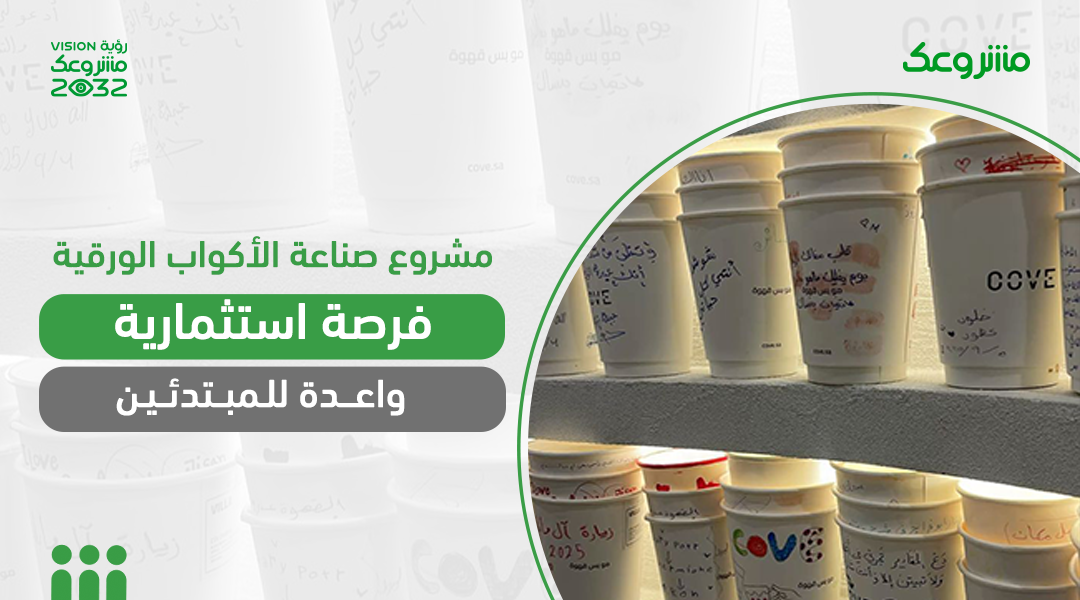
Today, the paper cup manufacturing project is considered one of the most prominent small investment opportunities attracting the attention of both entrepreneurs and investors. Its appeal lies in its ideal timing, which coincides with growing global environmental awareness and the fundamental shift away from plastic toward more sustainable alternatives. With increasing and recurring demand from cafés, restaurants, and beverage companies, the project stands out as a strategic option that balances low establishment costs with a rapid return on investment.
In the following sections, we explore everything required to launch a successful project in this promising sector, starting with developing the initial concept, through the technical and financial requirements and estimated costs, and ultimately uncovering the secrets to achieving sustainable profitability and ensuring long-term viability and competitiveness in a rapidly growing and dynamic market.
A paper cup manufacturing project is an industrial venture focused on producing environmentally friendly single-use cups designed to serve hot and cold beverages in cafés, restaurants, and at events. The production process begins by converting readily available and competitively priced raw materials—primarily paperboard treated with a thin layer of polyethylene or wax—into a finished product that meets safety and quality standards while also addressing the growing demand for biodegradable alternatives to plastic.
The project is characterized by operational flexibility that makes it accessible to entrepreneurs with limited capital, as it can be launched with a small production line at a reasonable cost, with the potential for gradual expansion in line with growing demand. This makes it an attractive investment opportunity for those seeking a sustainable industrial venture that combines rapid returns with a high capital turnover rate.
Read Here: Best Successful Small Projects for Youth in 2026
The global paper cup manufacturing market demonstrates positive indicators that support the feasibility of this project as a stable investment opportunity. The market was valued at approximately USD 11.35 billion in 2025 and is expected to reach USD 11.73 billion in 2026, growing to approximately USD 13.98 billion by 2034, at a compound annual growth rate (CAGR) of 2.55% during the forecast period. This steady growth confirms the continued demand for paper cups, driven by the expansion of the food and beverage sectors, alongside the global shift toward environmentally friendly products as an alternative to plastic, making the project a promising option for generating sustainable returns over the long term.
Read Here: Why Is a Cardboard Project Considered One of the Best Industrial Projects in 2026?
The cost of a paper cup manufacturing project depends on several key factors that determine the required investment size. The project can be implemented with flexible costs, ranging from a small-scale operation to a fully integrated manufacturing plant. The main cost elements include:
Read Here: How to Start Small Industrial Projects and Achieve Long-Term Financial Sustainability
Read here: How to Achieve Financial Success by Investing in Successful Small Projects
| Challenges | Proposed Solutions |
|---|---|
| High raw material costs and continuous price fluctuations | Contract with multiple suppliers and maintain appropriate inventory levels to reduce the impact of price fluctuations. |
| Strong market competition from local products and importers | Improve quality, offer competitive prices, and build a distinctive brand. |
| Machinery breakdowns and their impact on production continuity | Conduct regular maintenance, keep essential spare parts available, and implement a preventive maintenance plan. |
| Weak marketing channels and difficulty reaching customers | Develop an effective marketing plan, leverage digital marketing, and build a strong distribution network. |
| Lack of technical expertise among workers | Provide continuous employee training and seek specialized technical expertise when needed. |
| Difficulty complying with quality standards and specifications | Implement a strict quality control system and conduct regular product inspections before distribution. |
| Storage issues and exposure of products to environmental factors | Prepare suitable, dry storage facilities to maintain cup quality and prevent damage. |
| Delays in distribution and transportation | Contract with reliable shipping companies or establish an efficient in-house distribution system. |
| Complex legal procedures and licensing requirements | Engage a legal consultant to ensure all requirements are met quickly and efficiently. |
The decision to establish a paper cup manufacturing plant was not merely a passing step; it was a conscious response to market shifts and the growing demand for environmentally friendly alternatives. Although I had the enthusiasm and capital, I quickly realized that success in this field depends not only on ambition, but also on a clear, systematic vision and precise management of every aspect of the project—something I initially lacked.
This was the real turning point in my journey when I partnered with Mashroo3k Consulting, whose team prepared a comprehensive feasibility study covering every aspect of the project without exception. From a marketing perspective, the market was carefully analyzed, competitors were studied, and the target segments of cafés and restaurants were professionally identified. On the technical side, the appropriate machinery was selected, optimal production lines were determined, and the quality of raw materials was ensured to achieve the highest operational efficiency. As for the financial and administrative aspects, a clear structure for fixed and variable costs was developed, along with accurate cash flow projections and an organized workforce structure designed to achieve the highest level of productivity.
Despite the strength of the planning, I faced financing challenges, particularly due to the high cost of modern production lines compared with my available resources. However, the Mashroo3k team did not stop at preparing the study; they also developed a professional financing proposal that was submitted to the Saudi Industrial Development Fund. The project was presented in a compelling manner, supported by figures and analyses, which contributed to securing approval and financing within a record period.
Today, the project is built on strong foundations, with growing sales rates and successful partnerships established with several leading restaurant chains. This experience is no longer merely an industrial project; it has evolved into a practical model demonstrating that a promising idea, when supported by specialized expertise and professional planning, can overcome challenges and achieve sustainable success.
The price of the machine varies depending on its type (semi-automatic or fully automatic) and production capacity. Small machines are available for startups, while more advanced machines are designed for large-scale production. Prices also vary between locally manufactured and imported machines.
The price per ton of paper varies depending on its quality, coating type, thickness, and country of origin. There are economical raw materials as well as high-quality materials specifically designed for hot beverage cups.
The cost of the factory varies depending on the project size, number of machines, and production capacity. It is possible to start with a small-scale project and gradually expand into a fully integrated factory according to a well-planned strategy.
The price of a carton is determined by the number of cups it contains, product quality, and cup size. Prices also vary between wholesale and retail sales.
Yes, it is considered a profitable business due to the increasing demand for single-use paper products, particularly in restaurants and at events, with the potential to achieve a good profit margin when properly managed.
Among the most profitable industrial projects today are those based on fast-moving consumer products, such as paper cups, due to consistent demand and ease of marketing.
It is evident that this sector is steadily establishing its position as a comprehensive investment opportunity that combines stable demand, flexibility in implementation, and scalability. However, transforming this idea into a successful and sustainable project requires more than enthusiasm; it calls for precise planning, careful selection of production inputs, and well-developed marketing strategies. More importantly, success does not end at the establishment stage; it is renewed with every decision and with every shift in market and customer expectations. Quality and excellence are what ensure continuity in the face of competition, rather than production volume alone. A well-considered step today could be the true beginning of a more stable and impactful investment future.

For Inquiries and to Request a Feasibility Study for a Paper Cup Manufacturing Project
The kebab restaurant project is one of the food-service ventures that combines strong demand for grilled meals with the opportunity to target a diverse customer base, including individuals, families, and lovers of traditional Middle Eastern cuisine. With growing competition in the restaurant sector, however, the project’s success is no longer determined by food taste alone. […]
Read moreA children’s toy store project is not limited to selling toys; it is built on understanding what attracts children and what families look for when choosing products that combine entertainment and educational value. With the wide variety of educational toys, skill-development games, recreational toys, and gifts available, the store has opportunities to meet the needs […]
Read moreA residential complex project is no longer simply an investment in a collection of real estate units. It has evolved into an integrated development model that combines comfortable living, diverse services, and long-term investment value. As cities expand and residents’ needs evolve, demand is growing for residential complexes that offer a comprehensive environment suited to […]
Read moreThe veterinary clinic project comes at a time when animal care is no longer limited to treating illnesses or injuries, but has expanded to include health monitoring, vaccinations, routine checkups, and care for both pets and livestock. However, many animal owners face challenges in accessing specialized veterinary services that combine prompt response, high-quality care, and […]
Read more
خصم 25% على خدمات مشروعك استفد من العرض الآن، فالفرصة متاحة لفترة محدودة فقط
سجّل بياناتك واحصل على خصم 25% الآن


