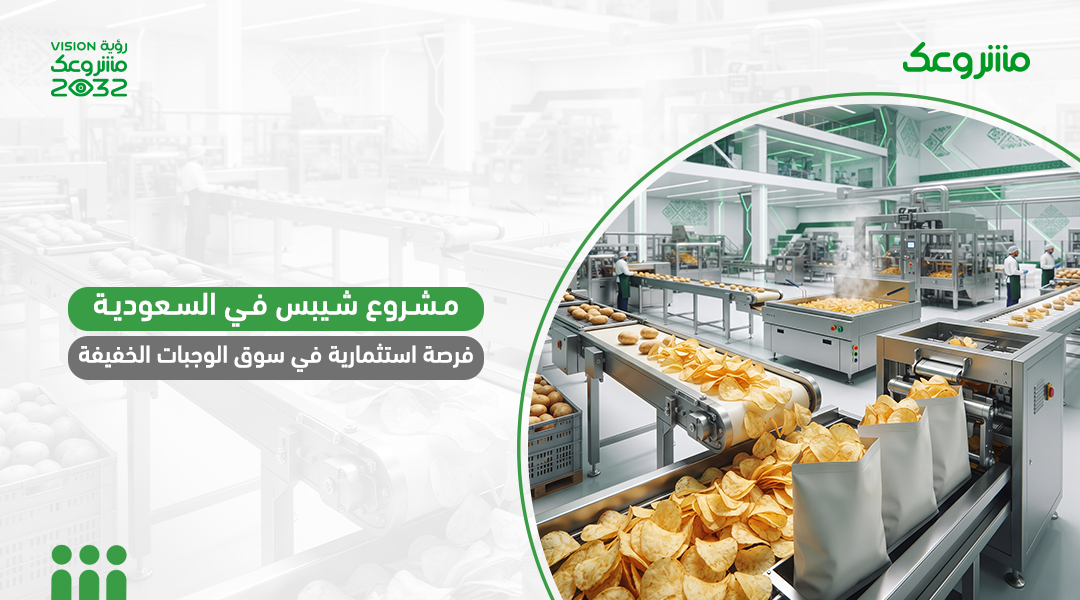
A chips business is considered one of the most in-demand and widely established food businesses in the Saudi market, as it is a daily consumer product that enjoys broad demand across different age groups, particularly children and young people. The business can generate attractive profits within a relatively short period, given the low cost of its basic production ingredients and the potentially high profit margin compared with the invested capital.
A chips business also gives investors flexibility in choosing an investment size that suits their needs, starting with limited production quantities to serve a small local market and scaling up to a fully integrated production line equipped with specialized machinery to meet the needs of larger markets.
In this context, we will explore everything related to this business, from its investment advantages and manufacturing stages to marketing strategies and ways to achieve the highest possible returns.
A chips business is a food manufacturing activity focused on producing crispy potato chips in various shapes and flavors. The process starts with peeling and slicing the potatoes into thin pieces, followed by frying or baking, adding different seasonings and flavors, and then packaging the product in a way that preserves its quality and crispiness for as long as possible.
Depending on the available capital and experience, the business owner can choose between two production models. The first is manual or semi-manual production using simple tools and equipment in a small space. The second is industrial production using specialized machinery that automates the slicing, frying, and packaging processes and allows for larger production volumes.
Read Here: Potato Cart Business in Saudi Arabia: A Low-Cost Investment Opportunity with Fast Returns
Yes, a chips business is considered one of the key industrial businesses in the food sector, supported by market statistics. The global potato chips marketwas valued at USD 60.29 billion in 2025 and is expected to grow from USD 64.64 billion in 2026 to USD 112.91 billion by 2034, registering a compound annual growth rate (CAGR) of 7.22% during the forecast period.
Read Here: Why Is a Potato Cold Storage Business Considered a Golden Opportunity in Agricultural Markets?
The cost of a chips business varies depending on the size of the project, the targeted production capacity, the type of equipment used, the project’s location, and the costs of raw materials, packaging, and operations. Therefore, it is important to determine the project’s requirements and carefully assess all cost items before starting. The main costs include:
Read Here: How to Start a Successful French Fries Business?
A market study for a chips business helps determine the level of demand for the product and identify target consumer segments, such as children, young people, and families. It also includes studying the products, flavors, and package sizes that are most in demand in the market, as well as analyzing competitors and examining their prices, product quality, packaging, and strengths and weaknesses. This helps determine the project’s competitive advantage.
It is also important to study consumer behavior and the factors influencing purchasing decisions, such as price, taste, quality, and package size, while identifying suitable sales channels such as grocery stores, supermarkets, food stores, restaurants, and distributors. This information helps develop an appropriate pricing, marketing, and distribution strategy, select products that meet market needs, and identify opportunities for future expansion and increasing the reach of the chips business.
Read here: How to Achieve Financial Success by Investing in Successful Small Projects
| Potential Risks | Mitigation Measures |
|---|---|
| Rising raw material prices | Work with multiple suppliers, monitor prices, and choose the right time to purchase. |
| Raw material spoilage | Provide suitable storage conditions, monitor inventory continuously, and implement an organized stock rotation system. |
| Declining product quality | Implement strict quality control procedures and inspect raw materials and products at different stages of production. |
| Equipment and machinery breakdowns | Conduct regular preventive maintenance and keep essential spare parts available. |
| Unexpected production stoppages | Establish a regular maintenance schedule and prepare suitable alternatives for emergency breakdowns. |
| Rising operating costs | Monitor energy and raw material consumption, reduce waste, and improve production efficiency. |
| Product damage during storage | Use suitable packaging and provide appropriate storage conditions to protect the chips from moisture and heat. |
| Product contamination | Follow hygiene and food safety standards and train employees on proper manufacturing procedures. |
| Weak demand for certain products | Monitor customer preferences and develop flavors and package sizes according to market needs. |
| Difficulty maintaining consistent product quality | Establish clear production standards and monitor every stage of the manufacturing and packaging processes. |
| Shortage of trained workers | Provide ongoing employee training and hire qualified staff with appropriate experience in equipment operation and production. |
| Damaged packaging or poor packaging quality | Inspect packaging materials and ensure proper sealing and closure before distributing the products. |
Making the decision to invest in a chips business in the Saudi market required careful consideration, especially with the growing demand for chips and snack products and the diversity of consumer needs. During the project preparation stage, I faced several challenges, including difficulties in planning accurately and a lack of clarity regarding the investment and operational requirements, as well as determining the required financing and finding a suitable source of funding. These challenges affected my ability to make clear decisions regarding the implementation of the project.
At this point, I sought the support of Mashroo3k Consulting to prepare a professional feasibility study for the project. The study included an analysis of the market and demand levels, an assessment of the technical and operational requirements, a calculation of the expected costs, revenues, and profits, as well as an evaluation of the project’s financing needs. The study helped me address the financial challenges I was facing and gain a clearer understanding of the project’s requirements. I was subsequently able to secure financing from the Saudi Industrial Development Fund,which helped me complete the project’s requirements and begin production in a more organized manner. As a result, the project became capable of operating more efficiently, with greater clarity in planning and managing its financial and operational aspects.
A chips-making machine is a set of equipment and machinery used to transform raw potatoes into chips ready for packaging. It includes various stages such as washing, peeling, slicing, frying, oil removal, seasoning, and finally filling and packaging. The specifications of a chips-making machine vary depending on the production capacity and factory size, so it should be selected according to the size of the chips business and the targeted production volume.
A potato chips slicing machine is designed to cut potatoes into slices with uniform thickness and size, ensuring product consistency and allowing the slices to be cooked and fried evenly. It is used in chips factories to increase production speed, reduce waste, and improve slice quality, with the ability to control slice thickness according to the type of product required.
Chips come in a variety of types depending on the manufacturing method, flavor, and product shape. The most common types include traditional potato chips made from potato slices, seasoned chips with various flavors, spicy chips, cheese-flavored chips, as well as chips made from corn or grains. Products also vary in terms of thickness, size, and slice shape to suit different consumer preferences.
Chips are manufactured through several stages, starting with selecting suitable potatoes and washing them thoroughly. The potatoes are then peeled and sliced into uniform pieces. The slices are prepared for frying and then fried until they reach the desired texture and color. Excess oil is removed before adding flavors and seasonings. In the final stage, the chips are cooled and packed into suitable packages, which are then sealed properly to preserve product quality and protect the chips from moisture and air
.In Conclusion: A Chips Business
This demonstrates that it is one of the most promising industrial investments in the food sector, thanks to its steady and consistent demand, which remains strong despite changing economic conditions. Chips are a staple product on the shelves of retail stores, supermarkets, and school cafeterias, and they enjoy strong demand across different age groups.
With proper production line planning, selecting machinery that matches the targeted production capacity, and maintaining high standards for raw materials and packaging, the factory owner can build a strong brand capable of competing effectively in the local market and eventually expanding into export markets. If you have a clear vision and sufficient capital to enter this field, establishing a chips business can be a smart investment step that opens up broad opportunities for sustainable profits and genuine growth.

To get in touch and request a feasibility study for a chips business.
The kebab restaurant project is one of the food-service ventures that combines strong demand for grilled meals with the opportunity to target a diverse customer base, including individuals, families, and lovers of traditional Middle Eastern cuisine. With growing competition in the restaurant sector, however, the project’s success is no longer determined by food taste alone. […]
Read moreA children’s toy store project is not limited to selling toys; it is built on understanding what attracts children and what families look for when choosing products that combine entertainment and educational value. With the wide variety of educational toys, skill-development games, recreational toys, and gifts available, the store has opportunities to meet the needs […]
Read moreA residential complex project is no longer simply an investment in a collection of real estate units. It has evolved into an integrated development model that combines comfortable living, diverse services, and long-term investment value. As cities expand and residents’ needs evolve, demand is growing for residential complexes that offer a comprehensive environment suited to […]
Read moreThe veterinary clinic project comes at a time when animal care is no longer limited to treating illnesses or injuries, but has expanded to include health monitoring, vaccinations, routine checkups, and care for both pets and livestock. However, many animal owners face challenges in accessing specialized veterinary services that combine prompt response, high-quality care, and […]
Read more
خصم 25% على خدمات مشروعك استفد من العرض الآن، فالفرصة متاحة لفترة محدودة فقط
سجّل بياناتك واحصل على خصم 25% الآن


