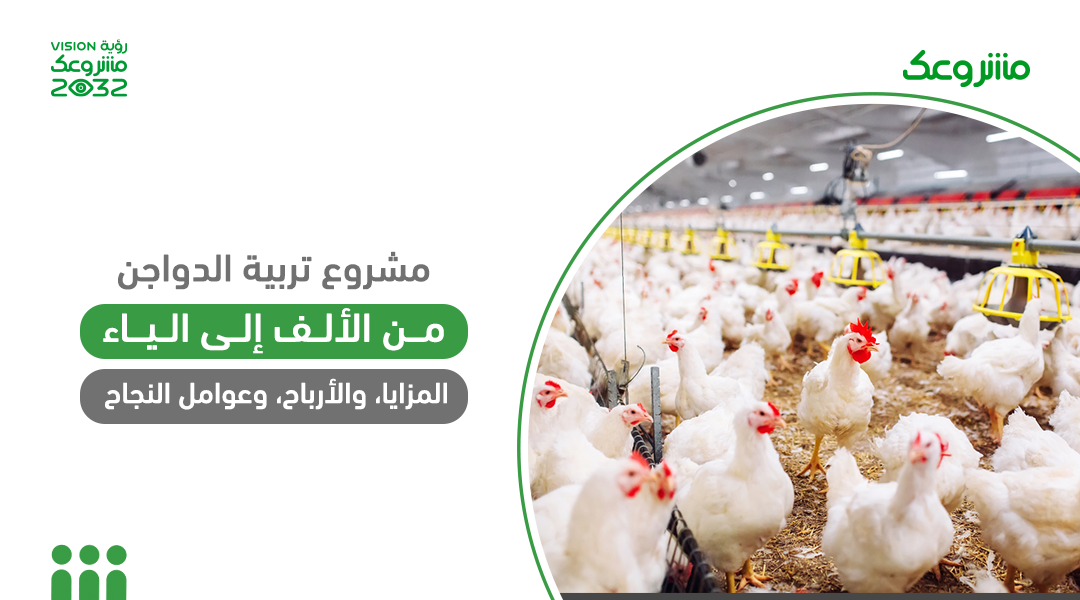
A poultry farming project is considered one of the most promising investment opportunities in the agricultural sector, driven by the continuous increase in demand for animal protein and the growing consumption of poultry meat. This activity is no longer a traditional business with limited capabilities; rather, it has evolved into an integrated production system based on precise scientific planning, specialized technical management, and the use of the latest technologies in nutrition, healthcare, and breed improvement.
This project provides investors with an opportunity to enter a vital sector characterized by rapid capital turnover, sustained demand, and the potential for well-planned expansion in line with market needs and quality and food safety standards. Therefore, a feasibility study for a poultry farming project is of strategic importance, as it represents a fundamental tool for ensuring economic viability, enhancing operational efficiency, and maintaining sustainable production over the long term.
A poultry farming project is a structured agricultural investment activity based on establishing a specialized farm equipped with modern poultry houses to produce poultry meat or eggs in commercial quantities that meet the needs of local and regional markets. The project relies on an integrated production system that includes selecting high-performance breeds, providing nutritionally balanced feed, implementing preventive veterinary healthcare protocols, and applying precise technical management throughout the entire rearing cycle.
This activity has evolved beyond its traditional nature into a professional economic venture built on preliminary feasibility studies and precise scientific planning, with optimal control of poultry housing environmental conditions to ensure the highest growth rates and production efficiency.
In light of global and local indicators, the profitability of a poultry farming project is increasingly evident, making it one of the most stable and growing agricultural investments. Globally, the poultry market is experiencing significant expansion, driven by rising demand for affordable animal protein. According to poultry farming market research, the market size is expected to increase from USD 394.75 billion in 2025 to USD 417.18 billion in 2026, at a compound annual growth rate (CAGR) of 5.7%. This upward trend is expected to continue, with the market projected to reach approximately USD 531.77 billion by 2030, at a compound annual growth rate (CAGR) of 6.3%.
At the local level, the poultry market in Saudi Arabia was valued at approximately USD 5.13 billion in 2025 and is expected to increase to USD 5.43 billion in 2026, with continued growth projected to reach approximately USD 7.22 billion by 2031, registering a compound annual growth rate (CAGR) of approximately 5.85% during the period from 2026 to 2032. Collectively, these indicators confirm the expanding consumer base, stable demand, and strong potential for generating returns, making poultry farming a highly viable investment with strong economic feasibility over the medium and long term, particularly when costs are managed efficiently and modern production standards are consistently maintained.
Please read here: Profitable Projects in Villages: Successful Investment Ideas with Low Operating Costs
The cost of establishing a poultry farming project varies depending on the farm size, type of production (broilers or layers), and the level of equipment and technology used. However, the required capital can be divided into three main categories as follows:
Please read here:Poultry Project Feasibility Study: Your Guide to Starting a Successful Investment
Opening a poultry farming project in the Kingdom of Saudi Arabia is subject to a number of regulatory and technical requirements aimed at ensuring project safety and compliance with approved environmental and health regulations. Obtaining the initial permit is an essential step, as it enables the investor to complete the remaining approvals from the relevant authorities, including the municipality and the National Center for Environmental Compliance, ensuring that the project is implemented in accordance with the applicable regulatory framework. The key requirements include:
For More Information on the Requirements for Opening a Poultry Farming Project in Saudi Arabia, Click Here
The production cycle for white broiler chickens typically ranges from 32 to 42 days in well-managed commercial operations and may extend to 45 days in small-scale projects to achieve a higher market weight. Profitability, however, varies significantly and depends on critical factors such as:
Yes, a poultry farming project can be a successful business when managed efficiently, given its consistent market demand, rapid capital turnover, and potential to generate stable profits when proper vaccination programs and sound management practices are followed.
Broiler farming is considered the most profitable in terms of the speed of generating returns, while layer farming provides a more stable income over the long term. Breeder farming can achieve higher profit margins, but it requires greater technical expertise and capital.
Broilers and layers differ in their production purpose, genetic characteristics, and production cycle. Broilers are raised for meat production over a short cycle of approximately 32 to 42 days, with a focus on rapid growth and efficient feed conversion. Layers, on the other hand, are raised for egg production, with production beginning at approximately 18–20 weeks of age and continuing for 52–60 weeks before the flock is replaced. The focus is on sustained and consistent production rather than rapid growth.
The key challenges in poultry farming include fluctuations in feed prices, high mortality rates resulting from inadequate healthcare, the spread of diseases, fluctuations in market selling prices, and the need for precise daily operational monitoring.
The productive age of a laying hen begins at approximately 18–22 weeks, when it lays its first egg, and it reaches peak production of approximately 90–95% between weeks 28 and 32. The full production cycle continues until approximately 72–80 weeks of age. Poultry is replaced at this stage not because of the end of its biological production capacity, but because declining production increases the cost per egg beyond the market price, making continued production economically unviable.
Read Here: How Can an Egg Incubation Project Generate High Returns at Low Costs?
A poultry farming project is a promising investment model in the animal production sector, supported by its short production cycle, consistent demand for animal protein, and potential for gradual expansion in accordance with quality standards. However, the success of the project does not depend solely on the size of the capital or the farm area; rather, it is based on three critical factors:
When these elements are combined with the adoption of modern technologies in nutrition and poultry housing environmental management, the project evolves from a traditional activity into an integrated production enterprise characterized by operational efficiency and competitiveness. As a result, it becomes an attractive option for investors seeking to build a medium-term project that combines profitability with operational sustainability in a market experiencing continuous growth in the consumption of poultry meat and eggs.

For Inquiries and to Request a Feasibility Study for a Poultry Farming Project
The kebab restaurant project is one of the food-service ventures that combines strong demand for grilled meals with the opportunity to target a diverse customer base, including individuals, families, and lovers of traditional Middle Eastern cuisine. With growing competition in the restaurant sector, however, the project’s success is no longer determined by food taste alone. […]
Read moreA children’s toy store project is not limited to selling toys; it is built on understanding what attracts children and what families look for when choosing products that combine entertainment and educational value. With the wide variety of educational toys, skill-development games, recreational toys, and gifts available, the store has opportunities to meet the needs […]
Read moreA residential complex project is no longer simply an investment in a collection of real estate units. It has evolved into an integrated development model that combines comfortable living, diverse services, and long-term investment value. As cities expand and residents’ needs evolve, demand is growing for residential complexes that offer a comprehensive environment suited to […]
Read moreThe veterinary clinic project comes at a time when animal care is no longer limited to treating illnesses or injuries, but has expanded to include health monitoring, vaccinations, routine checkups, and care for both pets and livestock. However, many animal owners face challenges in accessing specialized veterinary services that combine prompt response, high-quality care, and […]
Read more
خصم 25% على خدمات مشروعك استفد من العرض الآن، فالفرصة متاحة لفترة محدودة فقط
سجّل بياناتك واحصل على خصم 25% الآن


