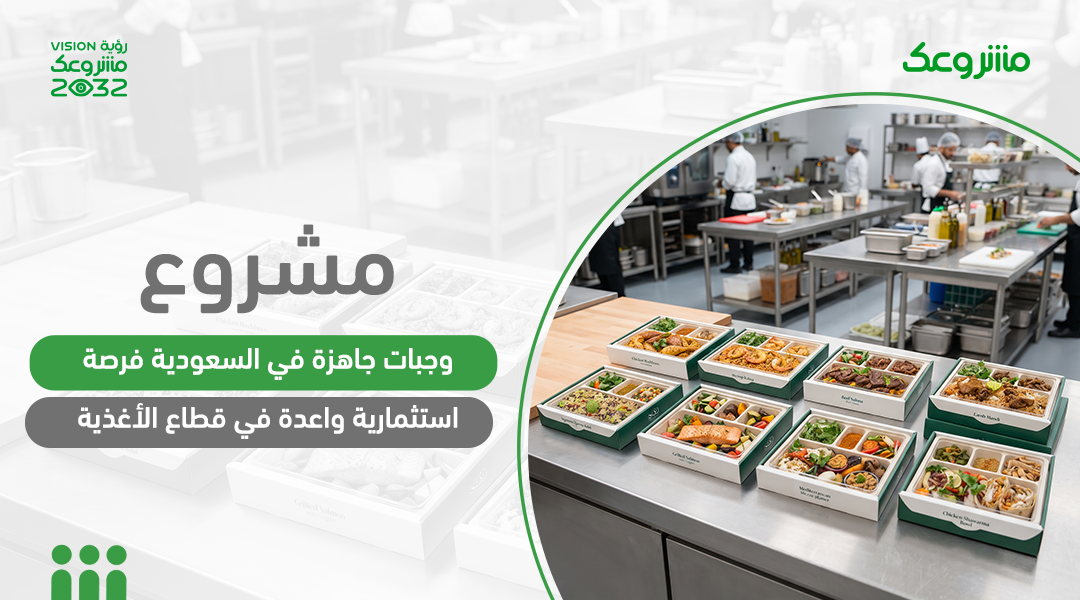
A ready-to-eat meals project is considered a promising investment opportunity in the food sector, particularly with the growing consumer demand for quick and ready-made meals that save time and effort and fit the fast-paced nature of everyday life. The project offers the flexibility to provide a diverse range of meals that cater to different tastes and needs, with the option to sell through the project’s premises or via delivery services and online platforms.
As competition in the food market continues to increase, the success of the project depends on product quality, menu variety, compliance with hygiene and food safety standards, appropriate pricing, and effective marketing. Therefore, careful planning and a thorough assessment of market requirements and anticipated costs before launching are essential steps toward building a project capable of generating attractive returns and achieving sustainable growth.
Read Here: Best Successful Small Projects for Youth in 2026
A ready-to-eat meals project is a food business specializing in preparing and producing a variety of cooked or semi-prepared meals, then packaging and serving them in a way that preserves their quality, taste, and food safety. The project targets individuals, families, employees, students, and others seeking quick and convenient meals without the need to prepare food at home.
The business can operate through direct sales from a dedicated location, or by receiving orders through online platforms and providing delivery services.
Read Here: Future-Proof Projects in Arab Countries: Key Investment Opportunities
Yes, a ready-to-eat meals project is considered one of the profitable investment opportunities, with the global ready-to-eat meals market valued at USD 193,618.9 million in 2026 and projected to reach USD 330,179.9 million by 2035, growing at a compound annual growth rate (CAGR) of 6.11%.
Read Here: Saudi Arabia Fast Food Market Report
Investors are increasingly interested in investing in ready-to-eat meals projects due to the many advantages they offer, including the following:
Read here: How to Start Investing in Successful Small Saudi Projects
The cost of a ready-to-eat meals project in Saudi Arabia varies depending on the project size, kitchen area, location, production capacity, type and quality of equipment, and number of employees, in addition to licensing, marketing, and delivery costs. The main cost items can be divided as follows:
Read here: How to Achieve Financial Success by Investing in Successful Small Projects
When I started operating a ready-to-eat meals project in the Kingdom of Saudi Arabia, I faced several challenges that affected workflow consistency and operational efficiency, despite the growing demand for ready-to-eat meals and the diverse needs of customers in the Saudi market. The most significant challenges included inadequate planning, unclear administrative procedures, and difficulties in organizing operations and distributing tasks among employees. I also faced challenges in managing resources and inventory and monitoring production stages, which created several obstacles and affected the smooth flow of operations.
To overcome these challenges, I sought the support of the experts at Mashroo3k Consulting, who prepared a comprehensive and professional feasibility study for me. The study included market analysis, identification of project requirements, estimation of expected costs and revenues, and organization of operational and administrative aspects. The company’s experts also provided practical solutions to the administrative challenges I faced and helped me establish clearer procedures for managing operations, assigning responsibilities, monitoring employee performance, and controlling resources and inventory. After implementing the recommendations outlined in the feasibility study, the project became more organized and stable, resource and operations management improved, and production efficiency increased. The project also became better equipped to meet customer needs and respond to demand through clear and effective operational processes, which positively impacted overall performance and helped me develop the project in a practical and tangible way.
A ready-to-eat meals project can offer a diverse selection of products to meet the needs of different customer segments, such as chicken and meat meals, grilled dishes, rice and pasta, sandwiches and burgers, family meals, salads and appetizers, and healthy low-calorie meals. The menu can also include breakfast meals and budget-friendly options, as well as meals for children and customized meals for employees and students. In addition, daily, weekly, and monthly meal packages can be offered to customers who prefer regular subscriptions.
A ready-to-eat meals project requires obtaining a commercial activity license, a food activity license or permit, and the relevant health approvals for the premises and kitchen. It may also require health certificates or medical examinations for employees involved in food preparation and handling.
In addition, the project must comply with food safety, hygiene, storage, preparation, and waste disposal requirements. Depending on the location, additional approvals may be required for commercial signage, fire protection systems, and other safety measures.
In a ready-to-eat meals project, meals are stored and preserved according to a system that ensures food quality and safety. Meals are placed in suitable, tightly sealed food-grade containers after preparation and then stored according to the nature of each product. Meals requiring refrigeration are kept in designated refrigerators, while frozen products are stored in appropriate freezers. Raw materials should be kept separate from ready-to-eat meals to prevent contamination.
Storage unit temperatures should also be monitored continuously, and containers should carry clear information including the product name, preparation date, and shelf life in accordance with applicable requirements. It is preferable to apply the First-Expired, First-Out (FEFO) system when managing inventory, while storage areas should be cleaned and sanitized regularly. Any products showing signs of spoilage should be discarded. These practices help maintain meal quality, reduce waste, and enhance consumer safety.
In conclusion, amid the growing demand for fast and convenient food solutions, a ready-to-eat meals project stands out as a business with strong potential for growth and attractive returns when implemented effectively. Success in this field begins with offering consistently high-quality meals, competitive pricing, and a diverse menu that meets customers’ needs, supported by efficient operations and a marketing strategy that reaches the target audience.
Before launching, careful planning can help determine the required investment, identify market opportunities, estimate expected profits, and address potential challenges through more informed decisions. Therefore, a feasibility study for a ready-to-eat meals project represents an important step in transforming the idea into a well-structured business with the potential for sustainability and expansion in the food market.

For inquiries and to request a feasibility study for a ready-to-eat meals project.
The kebab restaurant project is one of the food-service ventures that combines strong demand for grilled meals with the opportunity to target a diverse customer base, including individuals, families, and lovers of traditional Middle Eastern cuisine. With growing competition in the restaurant sector, however, the project’s success is no longer determined by food taste alone. […]
Read moreA children’s toy store project is not limited to selling toys; it is built on understanding what attracts children and what families look for when choosing products that combine entertainment and educational value. With the wide variety of educational toys, skill-development games, recreational toys, and gifts available, the store has opportunities to meet the needs […]
Read moreA residential complex project is no longer simply an investment in a collection of real estate units. It has evolved into an integrated development model that combines comfortable living, diverse services, and long-term investment value. As cities expand and residents’ needs evolve, demand is growing for residential complexes that offer a comprehensive environment suited to […]
Read moreThe veterinary clinic project comes at a time when animal care is no longer limited to treating illnesses or injuries, but has expanded to include health monitoring, vaccinations, routine checkups, and care for both pets and livestock. However, many animal owners face challenges in accessing specialized veterinary services that combine prompt response, high-quality care, and […]
Read more
خصم 25% على خدمات مشروعك استفد من العرض الآن، فالفرصة متاحة لفترة محدودة فقط
سجّل بياناتك واحصل على خصم 25% الآن


