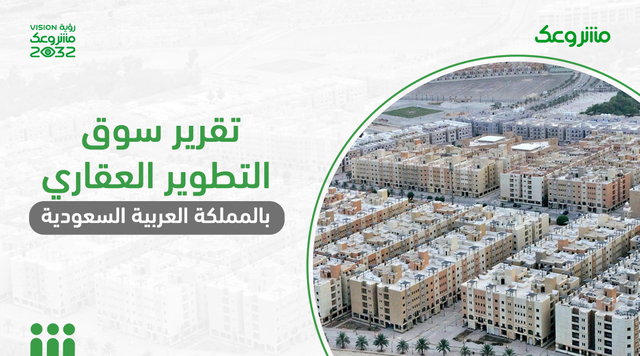
Saudi Real Estate Development Market Report - شركة Mashroo3k For consultations
Published08 Jul 2026 0 comments 165 Observation
Saudi Real Estate Development Market Report

The real estate development market in Saudi Arabia has experienced rapid growth in recent years, driven by Saudi Vision 2030, which aims to diversify the economy and reduce reliance on oil. The real estate sector is one of the key strategic sectors receiving significant government support, whether through new regulatory legislation or the launch of mega-projects such as NEOM, The Red Sea, Qiddiya, and housing projects under the Sakani Program.

The growing demand for residential units, driven by population growth and the increasing homeownership rate among citizens, has also stimulated the market and strengthened domestic and foreign investment. In addition, infrastructure development, an improved business environment, and streamlined ownership and investment procedures have attracted major real estate development companies to enter into strategic partnerships within the Kingdom.

The Saudi market offers diverse investment opportunities across the residential, commercial, administrative, hospitality, and mixed-use sectors, making it one of the most dynamic real estate markets in the Middle East. With continued economic reforms and major development projects, the real estate development sector is expected to continue playing a key role as a driver of economic growth in the Kingdom in the coming years.

National Strategy for Real Estate Development in Saudi Arabia

Saudi Arabia is experiencing growing demand for real estate, driven by rapid economic and social development, alongside the launch of numerous mega-projects that have contributed to diversifying the real estate supply and meeting the needs of different market segments. This comes within the framework of achieving the objectives of Saudi Vision 2030, which has placed real estate development in Saudi Arabia among its strategic priorities. Key objectives and initiatives in this sector include:

  • Increasing the homeownership rate among citizens to 70% by 2030 through supportive programs such as the Sakani Program and subsidized mortgage solutions, thereby enhancing family stability and quality of life.
  • Enabling foreign investors to own real estate and streamlining regulatory procedures to stimulate investment and attract global companies to participate in real estate development projects in Saudi Arabia.
  • Developing innovative and sustainable projects such as NEOM, The Line, and ROSHN, which rely on renewable energy and the use of artificial intelligence technologies, thereby promoting sustainability and enhancing quality of life.
  • Developing infrastructure and transportation networks to support urban expansion and improve connectivity between cities and key regions.
  • Launching major tourism projects such as The Red Sea, AlUla, and Qiddiya to support the tourism sector and increase demand for hospitality and residential properties associated with tourism and entertainment activities.
  • Updating and developing real estate laws and regulations, including the Real Estate Registration Law and property ownership regulations, to protect the rights of investors and citizens and enhance market transparency.

Read here: The Saudi Real Estate Market Under the Microscope: Indicators and Statistics Revealing the Sector’s Future

How Does Vision 2030 Support the Growth of the Real Estate Development Market in Saudi Arabia?

Saudi Vision 2030 supports the growth of the real estate development market in Saudi Arabia through an integrated set of programs, reforms, and major projects aimed at diversifying the economy, improving quality of life, and making the real estate sector a key driver of development. This support is reflected in several key areas:

Promoting Homeownership

The vision set a target of increasing the homeownership rate among citizens to 70% by 2030 through programs such as the Sakani Program and subsidized mortgage financing. This has increased demand for residential projects and encouraged developers to expand the construction of diverse housing units that meet the needs of different segments of the population.

Launching Mega-Projects

Major projects such as NEOM, The Line, The Red Sea, Qiddiya, and ROSHN have created significant investment opportunities and stimulated development across the residential, hospitality, retail, office, and mixed-use sectors.

Developing Regulations and Legislation

The government has worked to update real estate regulations, such as the Real Estate Registration Law, regulations governing off-plan sales, and measures to facilitate property ownership. These efforts have enhanced transparency, protected rights, and increased the confidence of local and foreign investors.

Attracting Foreign Investment

Through improving the business environment, allowing foreign ownership of real estate in designated areas, and providing investment incentives, Saudi Arabia has attracted global real estate development companies and fostered strategic partnerships.

Supporting Sustainability and Smart Cities

The vision encourages the development of projects that rely on renewable energy, advanced technologies, and artificial intelligence, promoting the concept of smart cities, improving quality of life, and attracting high-quality investments.

Developing the Tourism and Entertainment Sector

The vision aims to increase the number of tourists annually to 150 million by 2030, which has increased demand for hospitality, tourism, and commercial properties associated with entertainment and cultural activities.

Thanks to these integrated initiatives, the real estate development market in the Kingdom has become more organized, attractive, and sustainable, with expectations of continued growth in the coming years as one of the key sectors supporting economic transformation.

Read here: Construction and Building Sector Report in Saudi Arabia

The Role of Financing Institutions in Enhancing the Sustainability of Real Estate Development in Saudi Arabia

Financing institutions play a pivotal role in enhancing the sustainability of the real estate development sector in Saudi Arabia by providing diverse financing solutions that support developers and beneficiaries while contributing to market stability and long-term growth. This role is reflected in several key areas:

Providing Mortgage Financing to Individuals

Banks and financing companies offer subsidized mortgage financing programs in cooperation with government entities, such as the Real Estate Development Fund and the Sakani Program. This facilitates homeownership among citizens and supports sustainable demand for residential projects.

Financing Real Estate Development Projects

Banks and financial institutions provide developers with financing solutions, including construction loans, financing for major projects, and Islamic financing structures such as Murabaha and Ijarah, contributing to the efficient and sustainable implementation of projects.

Supporting Off-Plan Sales

Financing off-plan projects, in conjunction with regulatory frameworks such as the Wafi Program, helps strengthen trust between developers and buyers and ensures the availability of the liquidity required to complete projects according to established timelines.

Encouraging Long-Term Investments

Financing institutions support real estate investment through Real Estate Investment Traded Funds (REITs) and private investment funds, providing diverse financing channels and enhancing the continuity of financial flows within the sector.

Enhancing Financial Sustainability and Risk Management

Regulatory frameworks overseen by the Saudi Central Bank and the Capital Market Authority contribute to enhancing transparency and managing credit risks, thereby maintaining the stability of the real estate market and limiting severe fluctuations.

Supporting Sustainable Projects

Many financing institutions are increasingly supporting projects that comply with sustainability and energy-efficiency standards, in line with the objectives of Vision 2030 to develop smart and environmentally friendly cities.

Through this integration between financing institutions, government entities, and developers, a balance between supply and demand can be achieved, strengthening the sustainability of the real estate development sector as one of the Kingdom’s key drivers of economic growth.

Key Indicators of the Real Estate Development Sector in Saudi Arabia

  • Real estate market size: The Kingdom’s real estate market is expected to reach approximately USD 109.63 billion by 2030, reflecting the sector’s rapid growth and pivotal role in the national economy.
  • Market growth rate: The real estate market is recording an annual growth rate of 7.89%, confirming the sector’s attractiveness and continued demand across various property segments.
  • Construction and building permits: The number of construction and building permits is expected to reach 245,530 by 2030, at a growth rate of 5.4%, reflecting significant urban expansion and the scale of projects under development.
  • Construction companies: The number of construction companies operating in the market is expected to reach 385,719 by 2030, at a growth rate of 5.4%, demonstrating the sector’s expanding base and diversity of market players.
  • Occupied housing units: The number of occupied housing units in Saudi Arabia is expected to increase from 8,527,831 units in 2024 to 10,361,926 units in 2030.
  • The Saudi construction market is expected to grow from SAR 277.91 billion to SAR 360.99 billion.
  • Total number of contractors: In 2024, the number of contractors in the Kingdom reached approximately 20,812, including 19,179 Saudi contractors and 1,633 non-Saudi contractors, reflecting the dominance of national talent in the sector and its active contribution to urban development.
  • Value of construction project contracts: The value of construction project contracts in the Kingdom is expected to reach SAR 1.8 trillion by 2030, significantly increasing the sector’s contribution to GDP beyond its current share of 6%.
  • Building materials market size: The Saudi building materials market is expected to grow from SAR 4,658.63 million in 2024 to SAR 7,600.40 million by 2030.

SWOT Analysis of the Real Estate Development Market in Saudi Arabia

Strengths

  • Strong government commitment to developing the real estate sector as one of the pillars of Vision 2030 through supportive legislation, regulatory initiatives, and financing programs.
  • Implementation of transformative projects such as NEOM, The Line, Qiddiya, The Red Sea, and ROSHN, strengthening the Kingdom’s position as a leading global real estate investment destination.
  • A young population and high population growth rates creating sustained and increasing demand for residential and commercial properties.
  • Significant government investments in roads, airports, and public transportation, enhancing the attractiveness of newly developed urban areas.
  • Availability of multiple financing channels, such as the Real Estate Development Fund, banks, and the Sakani Program, facilitating homeownership and investment.
  • A reliable and attractive investment environment for local and foreign capital, supported by economic and political stability.

(Weaknesses)

  • High land prices represent a challenge for developers and directly affect the prices of final units.
  • The need for qualified technical and engineering professionals in certain specialized fields, along with a noticeable shortage of skilled labor.
  • Variations in construction quality among developers, particularly in medium-sized projects.
  • The continued length of certain regulatory and licensing procedures despite the improvements made in this area.
  • Heavy reliance on foreign labor in the construction and implementation sector, affecting cost and productivity stability.
  • Limited supply in certain segments, particularly affordable housing in major cities.

Opportunities

  • Increasing the homeownership rate among citizens to 70% under the objectives of Vision 2030 creates opportunities for additional residential projects.
  • New legislation allowing foreign investors to own real estate attracts global capital to the market.
  • Growth in the tourism sector and major tourism projects is creating increasing demand for hospitality and entertainment properties.
  • The transition toward smart cities is opening significant opportunities for developing projects that rely on technology and artificial intelligence.
  • The global and local shift toward sustainability and green buildings is strengthening opportunities for environmentally friendly and energy-efficient projects.
  • Expansion of Real Estate Investment Trusts (REITs) is attracting a broader range of investors and deepening real estate investment instruments.
  • Expansion of off-plan sales through the Wafi Program strengthens confidence and increases liquidity in the market.

Threats

  • Fluctuations in the prices of construction materials, particularly steel and cement, directly affect project implementation costs.
  • Global economic changes, such as inflation and rising interest rates, may affect mortgage financing and demand levels.
  • Regional competition from other real estate markets, such as the UAE and Qatar, for attracting foreign investment.
  • Risks of oversupply in certain sectors or regions as a result of the large-scale expansion of projects.
  • Rapid regulatory changes require continuous adaptation by developers and investors.
  • Environmental and climate challenges, such as water scarcity and high temperatures, affect project design and sustainability.
  • The dependence of some projects on oil prices means that any significant decline could affect the pace of government spending and related projects.

Read Here: Everything You Need to Know About SWOT Analysis and How It Is Applied

To communicate and learn more about Mashroo3k company and its services


Similar Articles

How to Turn a Kebab Restaurant Project into a Distinctive Brand in Egypt?

The kebab restaurant project is one of the food-service ventures that combines strong demand for grilled meals with the opportunity to target a diverse customer base, including individuals, families, and lovers of traditional Middle Eastern cuisine. With growing competition in the restaurant sector, however, the project’s success is no longer determined by food taste alone. […]

Read more

Children’s Play Center Project in Saudi Arabia: How to Create an Experience That Attracts Children and Families?

A children’s toy store project is not limited to selling toys; it is built on understanding what attracts children and what families look for when choosing products that combine entertainment and educational value. With the wide variety of educational toys, skill-development games, recreational toys, and gifts available, the store has opportunities to meet the needs […]

Read more

Residential Complex Project in Saudi Arabia: An Investment That Creates Value Beyond Residential Units

A residential complex project is no longer simply an investment in a collection of real estate units. It has evolved into an integrated development model that combines comfortable living, diverse services, and long-term investment value. As cities expand and residents’ needs evolve, demand is growing for residential complexes that offer a comprehensive environment suited to […]

Read more

Veterinary Clinic Project in Egypt: A Promising Investment Opportunity in the Animal Care Sector

The veterinary clinic project comes at a time when animal care is no longer limited to treating illnesses or injuries, but has expanded to include health monitoring, vaccinations, routine checkups, and care for both pets and livestock. However, many animal owners face challenges in accessing specialized veterinary services that combine prompt response, high-quality care, and […]

Read more

Green Friday

فرصة لا تتكرر

GREEN FRIDAY

خصم 25% على خدمات مشروعك استفد من العرض الآن، فالفرصة متاحة لفترة محدودة فقط
سجّل بياناتك واحصل على خصم 25% الآن