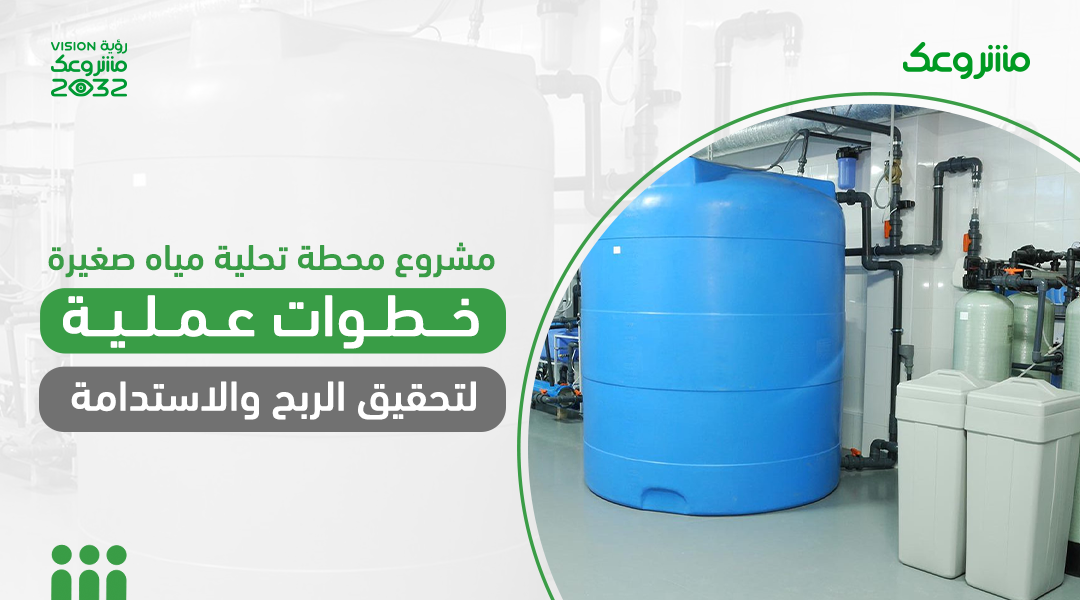
The small water desalination plant project has emerged as one of the most promising investment opportunities today, especially in light of the steadily increasing demand for clean water and rising consumption rates across various regions. With the growing challenges facing traditional water sources, investors and entrepreneurs are turning their attention to this sector as a strategic solution that combines economic viability with the fulfillment of an essential societal need.
Establishing a small desalination plant is a smart option that allows market entry with reasonable costs and stable returns, provided that planning is based on in-depth market research and the selection of the most suitable technologies. In the following lines, we explore the key aspects of this project, starting from its definition and importance, through to the implementation requirements and the critical factors to ensure its success and sustainability.
The small water desalination plant project is a productive service-based project aimed at treating saline or non-potable water and converting it into clean, safe water suitable for drinking or irrigation. This is achieved using advanced technologies such as reverse osmosis, which separates salts and impurities through specialized membranes under high pressure, ensuring high-quality water that meets health and environmental standards.
The project is characterized by its scalability, as it can be implemented on a small or medium scale, with a production capacity designed to match the needs of the target location—such as villages, remote areas, agricultural projects, or tourism and industrial facilities. This makes it a practical solution for addressing water scarcity and high salinity issues.
The project also contributes to providing a sustainable and reliable water source, with the possibility of bottling and selling the water or using it directly, depending on market demand.
Yes, indicators of the global water desalination technologies market reflect the strength of investment opportunities in this sector. The market was valued at approximately USD 27.8 billion in 2025, with projections indicating an increase to around USD 30.19 billion in 2026, and reaching approximately USD 59.34 billion by 2034, at a compound annual growth rate (CAGR) of about 8.85%.
In light of this rapid growth, the small water desalination plant project stands out as a promising investment opportunity, supported by the increasing demand for sustainable water solutions. This enhances its economic viability and opens up broad prospects for generating stable returns and achieving strong scalability in the future.
Read here: Why is a water filters project considered a distinguished investment opportunity in Egypt?
What is the cost of starting a small water desalination plant project?
The marketing feasibility study for a small water desalination plant aims to understand the size of demand in the target market and analyze existing competitors, while identifying the benefiting segments such as households, factories, and agricultural projects.
By estimating expected sales and setting an appropriate pricing strategy, the most effective distribution channels can be determined. The study also includes developing a well-planned marketing and promotion strategy, along with analyzing strengths, weaknesses, opportunities, and threats (SWOT), while considering future demand growth and the potential for expanding production capacity. This ensures the project’s continuity and achieves sustainable long-term profitability.
Please read here: Marketing Feasibility Study: Definition, Importance, Preparation Method, and Key Tools
The technical study of a small water desalination plant project focuses on the engineering and operational aspects to ensure the efficient and sustainable production of clean water. It includes identifying the raw water source, selecting the appropriate desalination technology, and designing the plant, including treatment units, tanks, filters, pumping systems, and disinfection systems.
It also involves selecting the necessary equipment and infrastructure, developing a regular operation and maintenance plan, and complying with health and environmental standards to ensure the continuity of the project and achieve the required water quality.
Read here: 7 Essential Elements Underpinning the Technical Feasibility Study of Projects
The financial feasibility study for a small water desalination plant focuses on estimating costs and revenues to ensure sustainable economic viability. It includes initial investment costs such as land, infrastructure, and equipment, in addition to operational costs such as wages, maintenance, energy, and water treatment materials.
It also involves estimating expected revenues from water sales and analyzing the break-even point, along with calculating key financial feasibility indicators such as Net Present Value (NPV), Internal Rate of Return (IRR), and the Payback Period. This is done while taking financial risks into consideration to ensure sound investment decision-making.
Read here: The Importance of Having a Financial Feasibility Study for Your Investment Project
The organizational and administrative feasibility study for a small water desalination plant focuses on establishing an appropriate organizational structure to ensure efficient workflow and the achievement of project objectives. It includes defining the required roles and responsibilities, ranging from a project manager and specialized technicians for operation and maintenance, to administrative and marketing support teams.
It also addresses the distribution of responsibilities among different departments, the establishment of clear operational policies and procedures, and the development of recruitment and continuous training plans for employees.
In addition, the study involves setting up performance monitoring and control systems to ensure quality and efficiency, as well as defining coordination methods between departments and enabling effective operational and administrative decision-making. This helps ensure business continuity and achieve long-term financial and operational sustainability for the project.
| Challenge | Proposed Solution |
|---|---|
| High operating and energy costs | Reduce costs by using energy-efficient technologies or integrating solar energy systems. |
| Difficulty in obtaining licenses | Comply with the required legal and health regulations and work with specialized consultants to properly complete procedures. |
| Competition with other desalination plants | Provide high-quality water, focus on customer service, and offer distinctive delivery services to gain customer trust. |
| Equipment and machinery failures | Contract with specialized technicians, perform regular maintenance, and replace filters and spare parts on schedule. |
| Weak marketing and customer reach | Rely on a clear marketing plan including local marketing and partnerships with stores, restaurants, and institutions in the area. |
| Fluctuating water demand affecting revenues | Secure fixed contracts with municipalities and factories to ensure stable sales. |
| Contamination of raw water and treatment difficulties | Install advanced filtration systems and pre-treatment units to ensure water quality. |
| Wear and tear of reverse osmosis membranes | Perform regular maintenance and cleaning, and use pre-filtration systems to extend membrane life. |
| Shortage of qualified technical labor | Provide continuous training programs and staff development to ensure efficient operations. |
To ensure the success and sustainability of a small water desalination plant project, proper planning and consideration of all operational, financial, and technical factors before implementation are essential. Success in this type of project depends on adhering to best practices, selecting the right location, ensuring the quality of produced water, along with effective management and regular maintenance. Below are the most important practical tips to help achieve continuity and profitability:
Despite (R.M)’s passion for entrepreneurship, a cloud of hesitation loomed over him. The idea of establishing a small water desalination plant was completely outside his expertise, and its challenges seemed overwhelming—from selecting the right location, identifying suitable equipment, and estimating market demand, to designing a successful marketing plan. All these complexities made him realize that his first step would be a risky venture.
A spark of hope appeared when he heard about a consulting firm called “Mashroo3k,” prompting him to contact them immediately. During the first meeting, his hesitation began to fade, and he gained confidence in the path ahead. The team provided comprehensive consultation, including a detailed feasibility study covering all critical aspects: technical (equipment selection), financial (costs and returns), marketing (targeting customers), and administrative (ensuring efficient operation and maintenance).
With this clear vision, (R.M)’s hesitation turned into certainty. He selected a strategic location, optimized production capacity, and built his distribution channels wisely, while his marketing strategy was ready before the first unit even started operating. When operations began, not only clean water flowed into homes, but also success and steady income.
Today, (R.M) looks back with pride, realizing that complexity is not a barrier to success but rather a motivation to seek the right support. His partnership with Mashroo3k consulting was the decisive factor that transformed his project from an idea into a tangible reality.
A small desalination plant can be established with a limited production capacity of a few thousand liters per day to serve households or small communities, allowing for low initial investment with the possibility of future expansion based on demand.
Requirements include a raw water source, pre-filtration systems to remove sediments, main desalination technologies such as reverse osmosis or distillation, chemical treatment for water quality, storage tanks, monitoring and control equipment, high-pressure pumps, distribution networks, and backup generators to ensure continuous operation.
The cost depends on production capacity, equipment, and technology used, in addition to site preparation, installation, labor, and maintenance costs. Higher capacity and advanced equipment increase the cost, so a detailed feasibility study is essential to determine an appropriate budget and ensure a safe investment.
Starting a bottled water business requires conducting a feasibility study to determine production scale and target market, preparing the site and obtaining necessary permits, purchasing appropriate desalination and bottling equipment, and developing an effective marketing plan to deliver high-quality bottled water to customers.
Yes, bottled water can be profitable if it focuses on water quality, proper hygiene standards, efficient bottling, and fast distribution. Demand for safe drinking water is high, especially in areas with limited access to clean water or where consumers prefer reliable bottled water.
A water distribution project aims to deliver potable water to households, restaurants, shops, and factories, whether through desalination plants or bottled water. It relies on an efficient distribution network to ensure continuous and timely delivery while maintaining water quality.
Read here: Successful Investment Projects in the Hydroponics Sector on the Occasion of World Water Day
The main components of a water distribution system include pipeline networks for transporting water, storage tanks to ensure availability and maintain stable pressure, and pumping stations to ensure water reaches all areas efficiently.
The requirements for opening a water desalination plant include obtaining the necessary legal and health licenses from the relevant authorities, selecting a suitable and easily accessible location, complying with water quality standards, performing regular maintenance of equipment, and providing all essential facilities for desalination, storage, and distribution to ensure efficient operation and sustainable returns.
It becomes clear that it goes beyond being a traditional investment opportunity; it is a bridge that connects sustainable profitability with meeting a pressing human need. In light of the growing scarcity of water resources, this project—supported by careful planning, a strategic location, and modern technologies—transforms into a promising facility that ensures stable financial returns. Therefore, preparing a feasibility study with precision is not merely a procedural step, but rather the cornerstone upon which the project’s success is built, and a guarantee for a prosperous future where investment grows alongside the needs of society.

To contact us and request a feasibility study for a small water desalination plant project
The kebab restaurant project is one of the food-service ventures that combines strong demand for grilled meals with the opportunity to target a diverse customer base, including individuals, families, and lovers of traditional Middle Eastern cuisine. With growing competition in the restaurant sector, however, the project’s success is no longer determined by food taste alone. […]
Read moreA children’s toy store project is not limited to selling toys; it is built on understanding what attracts children and what families look for when choosing products that combine entertainment and educational value. With the wide variety of educational toys, skill-development games, recreational toys, and gifts available, the store has opportunities to meet the needs […]
Read moreA residential complex project is no longer simply an investment in a collection of real estate units. It has evolved into an integrated development model that combines comfortable living, diverse services, and long-term investment value. As cities expand and residents’ needs evolve, demand is growing for residential complexes that offer a comprehensive environment suited to […]
Read moreThe veterinary clinic project comes at a time when animal care is no longer limited to treating illnesses or injuries, but has expanded to include health monitoring, vaccinations, routine checkups, and care for both pets and livestock. However, many animal owners face challenges in accessing specialized veterinary services that combine prompt response, high-quality care, and […]
Read more
خصم 25% على خدمات مشروعك استفد من العرض الآن، فالفرصة متاحة لفترة محدودة فقط
سجّل بياناتك واحصل على خصم 25% الآن


