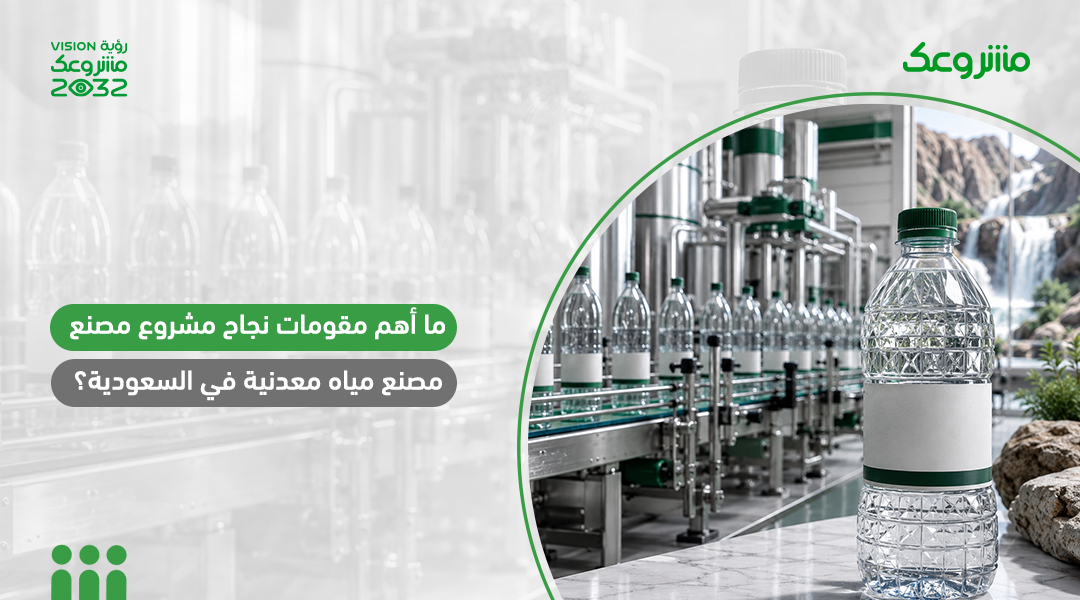
A mineral water factory project is considered one of the important industrial projects, as it is linked to providing an essential product that enjoys continuous demand from various groups. The project depends on purifying, treating, and packaging water according to approved specifications and requirements, with the possibility of producing containers in various sizes that suit the needs of individuals and establishments. The factory also makes it possible to target local markets and the restaurant, hotel, hospital, and store sectors, in addition to expanding through multiple distribution channels. Implementing the project requires an accurate study of the water source, production capacity, and suitable location, as well as choosing the necessary production lines and equipment. The study also includes legal and operational requirements, production costs, and marketing strategies. Building a strong brand and providing a safe, high-quality product helps enhance competitiveness. Therefore, identifying all the details of the project represents an essential step to evaluate its feasibility and prepare to implement it in an organized manner that achieves growth, continuity, and profitability.
A mineral water factory project is an industrial project specialized in producing and packaging natural mineral water in containers of different sizes, starting from extracting water from a suitable natural source, then subjecting it to permitted treatment and purification processes, and conducting the necessary tests to ensure its quality and safety, up to filling and packaging according to approved requirements and specifications. The project aims to meet the growing demand for bottled drinking water by providing a safe, high-quality product, with the possibility of distributing it through stores, retail outlets, restaurants, hotels, and various commercial outlets.
Read here: Successful Investment Projects in the Hydroponics Sector on the Occasion of World Water Day
Yes, a mineral water factory project is considered one of the most promising industrial investment opportunities, thanks to its high profitability. According to statistics, the global bottled water market was valued at approximately USD 7.35 billion in 2026. With continued growth, it is expected to reach USD 9.6 billion by 2035. The market is also projected to grow at a compound annual growth rate (CAGR) of 3% during the forecast period from 2026 to 2035.
A mineral water plant project is considered one of the promising investment opportunities due to its various advantages, including the following:
Read here: Why Is a Water Filters Project Considered an Outstanding Investment Opportunity?
The Saudi market has strong and sustained demand for bottled water, as it is an essential product used by households and individuals, as well as restaurants, hotels, cafés, commercial establishments, and the hospitality sector.
The Saudi Arabia bottled water market is estimated to be worth approximately USD 2.87 billion in 2025 and is expected to reach USD 3.97 billion by 2030, registering a compound annual growth rate (CAGR) of 6.70% during the forecast period. This reflects continued market growth and expanding investment opportunities.
The Kingdom’s climate, population and tourism growth, and the expansion of the restaurant and hospitality sectors also support demand for bottled water. This provides a suitable market base for a mineral water plant project, with opportunities to target multiple customer segments and expand distribution coverage according to production capacity and the target market.
The water production process in a mineral water plant goes through several consecutive stages aimed at treating the water and preparing it for bottling in accordance with quality and safety standards. These stages include:
The cost of a mineral water plant project is affected by several factors that vary depending on the project size, production capacity, location, and required equipment. The main factors include:
| Challenges | How to Overcome Them |
|---|---|
| High initial setup costs | Determine the appropriate production capacity and select equipment that aligns with the targeted investment size. |
| Intense market competition | Offer a consistently high-quality product, a distinctive brand identity, and competitive prices, while building a strong distribution network. |
| Compliance with quality and safety standards | Implement rigorous water testing systems, monitor all treatment and filling stages, and comply with approved regulatory requirements. |
| High operating costs | Improve production line efficiency, minimize waste, and closely monitor energy, raw material, and maintenance costs. |
| Securing a suitable water source | Select a reliable water source and conduct the necessary tests to ensure its suitability and continuity of supply. |
| Production line breakdowns | Conduct regular maintenance, maintain essential spare parts, and establish contingency plans to minimize production downtime. |
The steadily growing demand for bottled water in the Kingdom of Saudi Arabia, as confirmed by official statistics, encouraged me to expand my existing mineral water factory project. Despite the sector’s appeal, the development journey encountered investment and marketing obstacles. I struggled with uncertainty regarding the actual market demand, difficulty identifying the precise target customer segments and understanding their needs, as well as the lack of clear criteria for determining the optimal competitive price.
My greatest concern was the risk of investing in a market that might initially appear saturated and offer limited opportunities. Faced with these challenges, I became fully convinced that successful investment decisions cannot be based on assumptions; rather, they require specialized consultation grounded in data and figures. This realization led me to seek the services of Mashro’ak Consulting.
The company’s team of experts conducted extensive market research that served as a compass, efficiently guiding the project’s direction. They began with an in-depth analysis of data on current and projected supply and demand, conducted a detailed assessment of customers’ needs and preferences, and provided a comprehensive competitor survey covering the number of competitors, evaluating their operating methods, and comparing the prices of their products.
This analysis enabled me to identify the unique competitive advantages of our products, select the most appropriate strategies for launching them, and determine the ideal timing for making a strong entry into the market. The study also addressed risk management by providing a systematic assessment of the chances of success and potential challenges, supported by a genuine evaluation of customer opinions to verify the market’s need for the product.
These efforts culminated in identifying effective promotional methods to ensure penetration of the target markets and sustainable sales growth. Thanks to this systematic approach, all previous challenges were overcome, transforming the factory today into a well-organized investment venture with production and marketing efficiency that ensures its competitiveness and continuity in the market.
The required space varies depending on the production capacity and the size of the production lines. The facility should accommodate water treatment, filling, and packaging areas, raw material and finished product warehouses, administrative and service facilities, as well as loading and unloading areas and truck movement. It is also preferable to select a site that allows for future expansion and increased production capacity.
Establishing a mineral water plant in Saudi Arabia requires obtaining a number of licenses and approvals, including a Commercial Registration and a final Industrial License, in addition to approval from the Ministry of Environment, Water and Agriculture for the water source and an operating license from the Saudi Food and Drug Authority (SFDA). The project must also comply with site requirements and municipal regulations, obtain a Civil Defense permit or operating license depending on the plant’s location, and adhere to the health and technical requirements applicable to bottled water plants.
Yes. A mineral water plant requires an approved and reliable water source that is suitable for the nature of the activity and the plant’s production capacity. This may include a natural water source or a groundwater source, subject to the applicable licenses and regulatory requirements. The water must undergo the necessary testing and laboratory analyses to ensure compliance with health and safety standards before being used in production, along with obtaining the required approvals and permits for the source and its use.
The required workforce varies depending on the plant’s production capacity, the size of the production lines, and the level of automation. The workforce typically includes production supervisors, operation and maintenance technicians, filling and packaging workers, quality control technicians, as well as administrative staff, warehouse employees, sales personnel, and distribution staff. As production capacity increases and the distribution network expands, additional personnel may be required to ensure efficient operations and continuous production.
In conclusion, the mineral water plant project stands out as an investment opportunity driven by growing demand for bottled water, with strong potential for expansion and diverse sales channels. However, the success of the project depends not only on production capacity, but also on accurate market research, efficient production lines, compliance with regulatory requirements, and the ability to develop a competitive product that reaches consumers at the right time and place.
Therefore, conducting a feasibility study before implementation helps investors gain a clearer understanding of the required investment, costs, expected revenues, and key challenges and opportunities.
Are you looking for an investment opportunity in the water sector? Start by evaluating a mineral water plant project with Mashroo3k Consulting and make your investment decision based on accurate data and comprehensive analysis.

To get in touch to request a feasibility study for a bottled mineral water factory project
The kebab restaurant project is one of the food-service ventures that combines strong demand for grilled meals with the opportunity to target a diverse customer base, including individuals, families, and lovers of traditional Middle Eastern cuisine. With growing competition in the restaurant sector, however, the project’s success is no longer determined by food taste alone. […]
Read moreA children’s toy store project is not limited to selling toys; it is built on understanding what attracts children and what families look for when choosing products that combine entertainment and educational value. With the wide variety of educational toys, skill-development games, recreational toys, and gifts available, the store has opportunities to meet the needs […]
Read moreA residential complex project is no longer simply an investment in a collection of real estate units. It has evolved into an integrated development model that combines comfortable living, diverse services, and long-term investment value. As cities expand and residents’ needs evolve, demand is growing for residential complexes that offer a comprehensive environment suited to […]
Read moreThe veterinary clinic project comes at a time when animal care is no longer limited to treating illnesses or injuries, but has expanded to include health monitoring, vaccinations, routine checkups, and care for both pets and livestock. However, many animal owners face challenges in accessing specialized veterinary services that combine prompt response, high-quality care, and […]
Read more
خصم 25% على خدمات مشروعك استفد من العرض الآن، فالفرصة متاحة لفترة محدودة فقط
سجّل بياناتك واحصل على خصم 25% الآن


