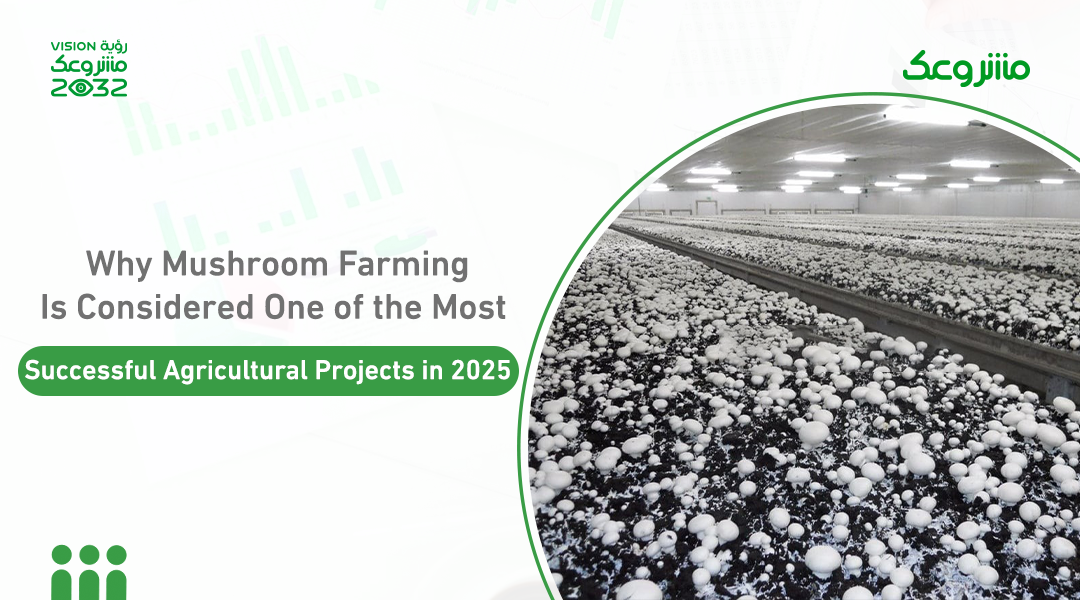
If you are looking for a smart investment that combines low risk with quick financial returns, mushroom farming is an ideal choice. This project does not require a large capital investment—you can start it with a limited budget—yet it provides steady profits thanks to the growing demand for mushrooms locally and globally. Mushrooms are valued as a healthy food rich in protein and vitamins and are also used in various pharmaceutical and cosmetic industries, which broadens their market potential.
Most importantly, they have a very short production cycle, allowing you to reinvest your capital several times a year. In addition, their flexible marketing options—whether sold fresh, dried, or canned—help reach diverse customer segments and increase profit opportunities. Therefore, mushroom farming is not just a traditional agricultural activity, but rather a strategic investment that ensures high returns with minimal effort and accessible resources.
A mushroom farming project is an innovative agricultural and investment activity focused on producing edible mushrooms in controlled environments using simple, readily available materials such as rice straw or sawdust as a growth medium.
It has a major competitive edge because it requires low setup costs compared to traditional farming projects and has a very fast production cycle (just a few weeks). This allows investors to achieve quick and repeated returns throughout the year.
Thanks to its flexible techniques and simple environmental control requirements, mushroom farming is an ideal choice for beginners and experienced investors alike, combining economic viability with scalability and sustainable profit potential.
Global market indicators show that the mushroom market is witnessing rapid growth, making mushroom farming an attractive and promising investment.
These figures reflect not only the growing demand for mushrooms as a healthy and functional food but also confirm that mushroom farming is a scalable and sustainable investment opportunity rather than just a seasonal agricultural activity.
Executive Summary
Provides an overview of the project idea, objectives, required investments, expected revenues, and payback period to give investors a quick view of its viability.
Market Study
Analyzes local and global demand, target customers (restaurants, hotels, supermarkets, vegetable stores), competitors, pricing strategies, and opportunities to expand.
Read more: Why Market Research Is Essential for Project Success
Technical Study
Covers site selection, space preparation (ventilation, humidity, temperature), required tools (plastic bags, racks, sterilization devices), suitable spawn and substrate selection, and operational planning.
Read more: 7 Key Elements of a Technical Feasibility Study
Financial Study
Estimates all startup and operational costs, including space setup, spawn purchase, raw materials (straw, sawdust), labor, electricity, and packaging.
Then calculates expected revenues based on production volume and selling prices to determine net profit, payback period, and ROI.
This provides a clear, numbers-based view of profitability.
Read more: The Importance of Financial Feasibility Studies
Organizational and Administrative Study
Defines the project’s organizational structure, workforce requirements, tasks, supervision mechanisms, and production/distribution workflow to ensure smooth operations and high-quality output.
Marketing Study
Develops a marketing plan including local markets, retailers, restaurants, hotels, and digital campaigns to raise awareness, plus promotions to attract and retain customers.
Read more: Your Complete Guide to Marketing Mix Strategies
Read more: Promotional Mix—Definition, Importance, Elements, and Key Factors
Legal Study
Identifies legal requirements such as agricultural and health licenses, food safety standards, labor regulations, environmental conditions, and permits to avoid future obstacles.
Read more: How Legal Feasibility Studies Ensure Project Success
➡️ These can be mitigated by adopting modern production techniques and preventive plans.
Administrative Permits
Required Documents
Other Requirements

For inquiries and to request a feasibility study for a mushroom farming project
The kebab restaurant project is one of the food-service ventures that combines strong demand for grilled meals with the opportunity to target a diverse customer base, including individuals, families, and lovers of traditional Middle Eastern cuisine. With growing competition in the restaurant sector, however, the project’s success is no longer determined by food taste alone. […]
Read moreA children’s toy store project is not limited to selling toys; it is built on understanding what attracts children and what families look for when choosing products that combine entertainment and educational value. With the wide variety of educational toys, skill-development games, recreational toys, and gifts available, the store has opportunities to meet the needs […]
Read moreA residential complex project is no longer simply an investment in a collection of real estate units. It has evolved into an integrated development model that combines comfortable living, diverse services, and long-term investment value. As cities expand and residents’ needs evolve, demand is growing for residential complexes that offer a comprehensive environment suited to […]
Read moreThe veterinary clinic project comes at a time when animal care is no longer limited to treating illnesses or injuries, but has expanded to include health monitoring, vaccinations, routine checkups, and care for both pets and livestock. However, many animal owners face challenges in accessing specialized veterinary services that combine prompt response, high-quality care, and […]
Read more
خصم 25% على خدمات مشروعك استفد من العرض الآن، فالفرصة متاحة لفترة محدودة فقط
سجّل بياناتك واحصل على خصم 25% الآن


