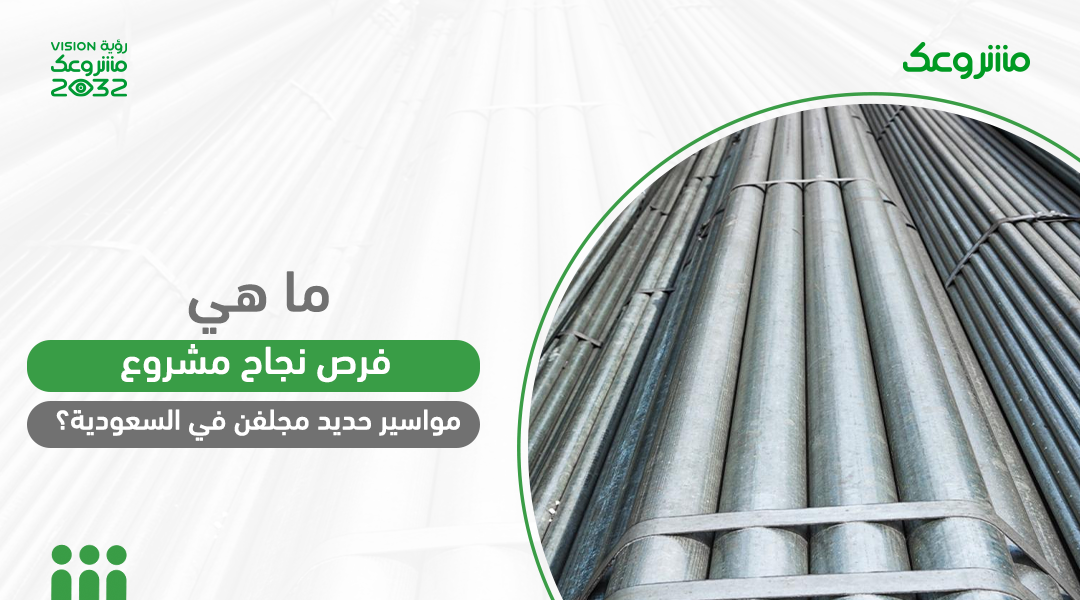
What Are the Success Prospects for a Galvanized Steel Pipe Project in Saudi Arabia? - Mashroo3k
Published13 Oct 2026 0 comments 66 Observation
What Are the Success Prospects for a Galvanized Steel Pipe Project in Saudi Arabia?

The galvanized steel pipe project is considered one of the key industrial ventures that may offer a promising investment opportunity, particularly given the wide range of applications for galvanized pipes in construction, water supply and irrigation networks, and various industrial uses. Demand for these pipes is driven by their ability to withstand different environmental conditions and resist rust and corrosion, making them products with ongoing market demand.
However, before launching the project, several factors must be carefully evaluated, starting with selecting the appropriate location, equipment, and raw materials, followed by determining production capacity and workforce requirements, and calculating expected costs and potential profits.
Therefore, if you are considering investing in a galvanized steel pipe project, this article provides a comprehensive overview of the project’s key requirements, costs, implementation stages, and major success factors that can help establish a competitive business and achieve a favorable return on investment.

What Is the Concept of a Galvanized Steel Pipe Project?

The concept of a galvanized steel pipe manufacturing project involves establishing an industrial facility specializing in producing steel pipes and coating them with a layer of zinc to protect them against rust and corrosion while enhancing their durability and service life. The project aims to meet the needs of various sectors, including construction, water supply and irrigation networks, infrastructure, and industrial applications.

The production process involves forming and welding steel to achieve the required pipe diameters and thicknesses, followed by galvanizing, finishing, and inspection processes to ensure product quality and compliance with technical specifications. This helps ensure a reliable supply of products that meet market requirements.
Read Here: Steel Factory Project in Saudi Arabia: From Concept to Operation and Success

Is a Galvanized Steel Pipe Project Worth Investing In?

Yes, a galvanized steel pipe project is considered a promising investment opportunity in the industrial sector, driven by growing demand for galvanized steel and its diverse applications across construction, infrastructure, and manufacturing. According to statistics,the global galvanized steel market was valued at approximatelyUSD 110.07 billion in 2025 and is projected to grow to USD 116.72 billion in 2026, reaching USD 186.82 billion by 2034, at a compound annual growth rate (CAGR) of 6.10% over the forecast period.

Read here:Industrial Sector Report in Saudi Arabia

Importance of a Galvanized Steel Pipe Project in the Saudi Market

  • Meeting the demand for galvanized pipes in the construction sector.
  • Supporting the needs of infrastructure and utilities projects.
  • Providing products that resist rust and corrosion and offer a long service life.
  • Serving the water, irrigation, industrial, and construction sectors.
  • Diversifying the customer base to include contractors, suppliers, and factories.
  • Reducing reliance on imported products and supporting local manufacturing.
  • Capitalizing on the growth of industrial and construction projects in the Kingdom.
  • Offering a variety of pipe sizes and thicknesses to meet market requirements.
  • Creating opportunities to expand production and enter new markets.
  • Strengthening investment opportunities in the metal industries sector in Saudi Arabia.

Key Requirements for a Galvanized Steel Pipe Project

  • Selecting a suitable industrial location that meets the nature of the business and provides convenient access to raw materials and finished products.
  • Providing sufficient factory space for production lines, storage areas, operations, and material handling.
  • Installing suitable manufacturing and galvanizing lines and equipment to produce pipes in the required sizes and thicknesses.
  • Securing raw materials, such as steel coils and sheets, zinc, and auxiliary production materials.
  • Ensuring a stable supply of energy and water to operate equipment and carry out manufacturing and galvanizing processes.
  • Hiring qualified technical and administrative personnel to operate production lines and oversee quality control and maintenance.
  • Implementing quality control systems to ensure that pipes comply with the required specifications and standards.
  • Providing occupational safety systems to protect workers and ensure the safe handling of equipment and materials.
  • Establishing suitable warehouses to store raw materials and finished products in an organized and secure manner.
  • Obtaining the necessary licenses and approvals in accordance with the regulations and requirements in force in the Kingdom.
  • Developing effective marketing and distribution channels to reach construction companies, suppliers, factories, and target customers.

What Are the Main Cost Components of a Galvanized Steel Pipe Project?

  • The cost of purchasing and preparing the project site to meet operational and production requirements.
  • The cost of production and galvanizing lines and equipment required to manufacture and process the pipes.
  • The cost of purchasing raw materials, including steel, zinc, and auxiliary manufacturing materials.
  • Utility and energy costs, including electricity, water, fuel, and other services required for operations.
  • Labor costs and wages for workers, technicians, administrative staff, and supervisors.
  • Maintenance and spare parts costs to maintain equipment efficiency and ensure production continuity.
  • Quality control and testing costs to verify that products meet the required specifications and standards.
  • Packaging, storage, and product preparation costs to ensure proper preservation, transportation, and distribution.
  • Transportation and logistics costs for delivering raw materials and distributing finished products to customers.
  • Marketing and administrative expenses related to product promotion, sales management, and operations.
  • Licensing, insurance, and regulatory compliance costs associated with establishing and operating the factory.
  • Working capital to cover operating expenses and raw material purchases during the initial operating period.

Equipment Required for a Galvanized Steel Pipe Project

  • Steel coil decoiling and leveling line: Prepares raw materials and flattens them before they enter the manufacturing stages.
  • Pipe-forming machine: Converts steel strips into circular or other required shapes according to product specifications.
  • Longitudinal welding machine: Joins the edges of steel strips to form a strong, continuous pipe body.
  • Pipe sizing and cutting machine: Cuts finished pipes to the required lengths and dimensions.
  • Surface cleaning and preparation equipment: Removes impurities, oils, and rust before galvanizing.
  • Zinc galvanizing line: Coats the pipe surfaces with a protective layer of zinc to help resist corrosion and rust.
  • Treatment and preparation tanks: Carry out cleaning, pickling, and chemical preparation stages according to the production system used.
  • Cooling and drying equipment: Prepares pipes after manufacturing and galvanizing.
  • Inspection and quality control equipment: Measures dimensions and thicknesses and tests weld quality and galvanizing coating performance.
  • Material handling and lifting equipment: Such as forklifts and cranes for moving steel coils and pipes throughout the factory.
  • Packaging equipment: Bundles, secures, and prepares pipes for storage and transportation.
  • Industrial safety equipment and ventilation systems: Provide appropriate protection for the specific manufacturing and galvanizing processes.

Raw Materials Used in a Galvanized Steel Pipe Project

  • Steel coils and strips: The primary raw materials used to manufacture pipes. They are formed and welded to achieve the required diameters and thicknesses according to market needs.
  • Zinc: Used in the galvanizing process to create a protective coating on pipe surfaces, helping resist rust and corrosion and extend service life.
  • Welding materials: Used to weld the edges of steel strips as they are formed into pipes. The type depends on the welding technology used in the factory.
  • Surface treatment chemicals: Include cleaning, degreasing, oxide removal, and pickling agents. These prepare steel surfaces before galvanizing to ensure effective zinc coating adhesion.
  • Finishing and protective materials: May include final treatment materials or additional coatings, depending on technical specifications and customer requirements.
  • Packaging materials: Such as protective strapping, covers, and labels, used to bundle pipes and protect them during storage and transportation.

What Are the Specifications of a Suitable Location for a Galvanized Steel Pipe Project?

  • A site within an industrial zone whose regulations and requirements are compatible with the nature of the industrial activity and galvanizing operations.
  • Sufficient factory space to accommodate production lines, galvanizing equipment, storage areas, material handling, and packaging.
  • Easy access to major roads to facilitate raw material transportation and pipe distribution to customers and target markets.
  • Proximity to raw material suppliers to reduce transportation costs and ensure a consistent supply of steel, zinc, and auxiliary materials.
  • Reliable infrastructure, including electricity, water, drainage, and other services required for efficient factory operations.
  • Dedicated storage areas to separate raw materials from finished products and protect them from damage or improper storage.
  • Appropriate ventilation systems to safely manage fumes and substances generated during treatment and galvanizing processes.
  • Convenient truck access and sufficient space for loading, unloading, and handling pipes.
  • Distance from residential areas in compliance with the environmental and industrial requirements applicable to the activity.
  • Potential for future expansion, allowing the installation of additional equipment or production lines and increased production capacity as the project grows.

Key Challenges Facing a Galvanized Steel Pipe Project

  • High raw material costs and fluctuations in steel and zinc prices, which may affect production costs and profit margins.
  • High energy and operating costs due to the project’s reliance on multiple industrial production lines and machines.
  • The need to comply with quality standards to ensure that pipes meet the technical specifications required by the market.
  • Challenges associated with galvanizing, which requires precise operating techniques and technical expertise to maintain consistent zinc coating quality and thickness.
  • Market competition from local factories and imported products, requiring competitive product quality and pricing.
  • Recruiting specialized technical personnel capable of operating production lines and galvanizing equipment and performing maintenance.
  • Environmental and industrial requirements related to treatment and galvanizing processes and the handling of chemicals and waste.
  • Maintaining uninterrupted production and preventing unexpected equipment failures that could halt manufacturing lines and delay orders.
  • Storage and transportation challenges arising from pipe dimensions and weight, which require suitable handling and loading arrangements.
  • Building a strong distribution network to reach construction companies, suppliers, factories, and target customers.

Read here:Risk management in projects: What is it, what is its importance, and how can it be implemented?

How to Increase Sales for a Galvanized Steel Pipe Project

  • Expand the distributor network by partnering with building materials retailers and suppliers across different regions of the target market.
  • Target construction companies with tailored supply offers for construction and infrastructure projects.
  • Diversify product sizes and thicknesses to meet the needs of different sectors and customers and increase sales opportunities.
  • Offer competitive prices while maintaining product quality to attract customers and preserve profit margins.
  • Provide flexible supply arrangements and adhere to delivery schedules to build customer trust and encourage repeat purchases.
  • Create a customer database and follow up with existing and prospective customers through regular offers and new supply opportunities.
  • Strengthen the digital presence through the company website, social media platforms, and search engines to reach customers looking for these products.
  • Participate in tenders and major projects to increase contract volumes and open new sales channels.
  • Offer bulk-purchase deals and suitable incentives for distributors and regular customers to encourage larger orders.
  • Focus on after-sales service and respond promptly to inquiries and complaints to build long-term customer relationships.

Read here: All the secrets to profiting from a building materials store project.

My Experience with a Galvanized Steel Pipe Project

My experience with a galvanized steel pipe project was a successful investment journey that allowed me to benefit from the growing demand for galvanized pipe products and their diverse applications across the construction, utilities, and industrial sectors in Saudi Arabia. As the project grew and production volumes and orders increased, I had a genuine opportunity to expand its capabilities and improve operational efficiency.
However, expansion revealed several technical challenges that had not been as apparent during the initial stages of operation. I encountered inconsistencies in forming and welding, variations in zinc coating thickness, and inadequate preparation of steel surfaces before galvanizing. Equipment malfunctions also emerged, along with issues affecting dimensional and thickness accuracy. Maintaining consistent product quality became a challenge that required specialized solutions.

I realized then that sustaining the project’s growth required more than simply increasing production; it called for addressing the root causes of the technical problems. Therefore, I turned to Mashroo3k Consulting for specialized support. The Mashroo3k team examined the technical issues, evaluated the production lines and equipment, reviewed raw material specifications, and developed more precise procedures for quality control and operational efficiency.
The proposed solutions also helped reduce equipment breakdowns and waste while improving the stability of the production process. With these solutions in place, the project became more organized and efficient, product quality improved, and production became more consistent. I also gained a greater capacity to continue developing the business and capitalize on growth opportunities in the market.

Read Here: Why Is Mashroo3k Consulting the Best Feasibility Study Company?

Read Here: Why Is Mashroo3k the Best Feasibility Study Firm?

Frequently Asked Questions About a Galvanized Steel Pipe Project

What Are Galvanized Steel Pipes?

Galvanized steel pipes are pipes made of iron or steel and coated with a layer of zinc through a galvanizing process to protect them against rust and corrosion and extend their service life. They are characterized by their durability and ability to withstand various environmental conditions. Therefore, they are used in a wide range of applications, including water supply and irrigation networks, construction, infrastructure, and industrial applications.

What Are the Types of Steel Pipes?

Steel pipes vary according to their manufacturing methods and applications. The main types include welded and seamless pipes, as well as galvanized pipes, which are coated with zinc to protect them against rust and corrosion. Other types include black steel pipes and carbon steel pipes, which are used in construction, industrial applications, and the transportation of liquids and gases.

What Is the Best Type of Pipe in Saudi Arabia?

The choice depends on the nature of the project, pressure requirements, and operating conditions. However, galvanized steel pipes are a suitable option for many applications that require durability and corrosion resistance, particularly in certain water supply, construction, and utilities projects. Pipe products in the Kingdom are subject to technical regulations and specifications that define the requirements for products used in water, electricity, and gas networks. Therefore, the appropriate pipe type and specification should be selected according to the intended application and applicable standards.

What Are the Main Uses of Galvanized Steel Pipes?

Galvanized steel pipes are used in various fields, most notably water supply and irrigation networks, construction and infrastructure projects, metal structures and frameworks, and electrical conduits. They are also used in certain industrial and commercial applications that require pipes with durability and resistance to rust and corrosion.

What Is the Difference Between Galvanized Steel Pipes and Ordinary Steel Pipes?

The main difference lies in surface treatment and corrosion protection. Galvanized steel pipes are coated with a layer of zinc that protects the steel against rust and corrosion, making them more suitable for environments exposed to moisture and weather conditions. Ordinary steel pipes do not have this protective coating and are therefore more susceptible to rust, requiring additional protective measures or coatings when used under certain conditions.

In conclusion, regarding the galvanized steel pipe project,

We can conclude that this project has the potential to grow as an industrial venture, particularly given the wide range of applications for its products across multiple sectors and their role in meeting essential needs in construction, utilities, and industry. However, turning this opportunity into a successful business requires a clear vision that begins with understanding the market and identifying the most in-demand products, followed by developing an operational model that balances production quality, manufacturing costs, and competitiveness.
With proper planning, the selection of appropriate technology, and the establishment of a strong network of customers and distributors, the project can expand gradually and strengthen its market presence. Therefore, a specialized feasibility study remains an important step in determining the required investment, evaluating economic viability, and establishing the foundations for making an informed investment decision before implementation begins.

Contact Us to Request a Feasibility Study for a Galvanized Steel Pipe Project.


Similar Articles

How to Turn a Kebab Restaurant Project into a Distinctive Brand in Egypt?

The kebab restaurant project is one of the food-service ventures that combines strong demand for grilled meals with the opportunity to target a diverse customer base, including individuals, families, and lovers of traditional Middle Eastern cuisine. With growing competition in the restaurant sector, however, the project’s success is no longer determined by food taste alone. […]

Read more

Children’s Play Center Project in Saudi Arabia: How to Create an Experience That Attracts Children and Families?

A children’s toy store project is not limited to selling toys; it is built on understanding what attracts children and what families look for when choosing products that combine entertainment and educational value. With the wide variety of educational toys, skill-development games, recreational toys, and gifts available, the store has opportunities to meet the needs […]

Read more

Residential Complex Project in Saudi Arabia: An Investment That Creates Value Beyond Residential Units

A residential complex project is no longer simply an investment in a collection of real estate units. It has evolved into an integrated development model that combines comfortable living, diverse services, and long-term investment value. As cities expand and residents’ needs evolve, demand is growing for residential complexes that offer a comprehensive environment suited to […]

Read more

Veterinary Clinic Project in Egypt: A Promising Investment Opportunity in the Animal Care Sector

The veterinary clinic project comes at a time when animal care is no longer limited to treating illnesses or injuries, but has expanded to include health monitoring, vaccinations, routine checkups, and care for both pets and livestock. However, many animal owners face challenges in accessing specialized veterinary services that combine prompt response, high-quality care, and […]

Read more

Green Friday

فرصة لا تتكرر

GREEN FRIDAY

خصم 25% على خدمات مشروعك استفد من العرض الآن، فالفرصة متاحة لفترة محدودة فقط
سجّل بياناتك واحصل على خصم 25% الآن