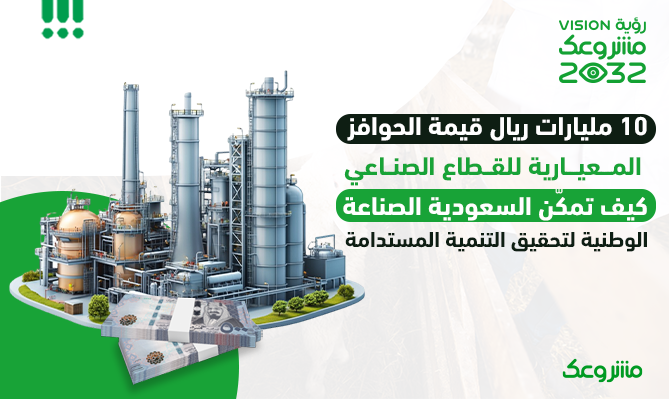
In a strategic move aimed at enhancing the role of the industrial sector in the Kingdom of Saudi Arabia, the Ministry of Industry and Mineral Resources, in cooperation with the Ministry of Investment, announced the allocation of 10 billion Saudi riyals to activate the standard incentives program for the industrial sector, within the framework of the Kingdom’s Vision 2030, which places industry as one of the main axes for achieving sustainable economic development.
During the ceremony in which the details of the program were announced, His Excellency the Minister of Industry and Mineral Resources, Eng. Bandar Alkhorayef, stressed that this program is the first of its kind in the region; as it seeks to develop the industrial sector and enhance its sustainability by supporting the manufacturing of products that are not currently produced within the Kingdom using national resources and increasing reliance on local competencies. In addition to opening new horizons for qualitative industrial investments and accelerating their pace, while ensuring their continuity in the long term.
For his part, His Excellency the Minister of Investment, Eng. Khalid Al-Falih, pointed out that the Standard Incentives Program represents a pivotal step within the National Investment Strategy, as it contributes significantly to attracting and developing industrial investments, which enhances the competitiveness of the Saudi industrial sector. He also added that the projects targeted within the framework of these incentives are expected to contribute to achieving an annual GDP estimated at about 23 billion Saudi riyals.
The Standard Incentives for the Industrial Sector in the Kingdom of Saudi Arabia represent a strategic initiative aimed at promoting industrial growth and achieving the goals of Vision 2030. These incentives contribute to supporting innovative projects and developing industrial capabilities by focusing on sectors and products that are not produced locally, thus achieving economic diversification and self-sufficiency. They also enhance foreign direct investment by attracting new investors who are not established in the Kingdom, and provide financial support covering up to 35% of the eligible initial investment with a maximum of 50 million Saudi riyals for each project, divided into 50% for the construction phase and 50% for the production phase. In addition, these incentives ensure the sustainability of financial and operational performance over a period of seven years during the construction and operation phases, which enhances the ability of manufacturing projects to achieve success and expansion.
The standard incentives for the industrial sector aim to achieve a set of strategic objectives that contribute to enhancing economic growth, increasing the industrial sector’s contribution to the GDP, and supporting sustainable development. The most prominent of these objectives are:
The Ministry of Industry and Mineral Resources and the Ministry of Investment have revealed a set of incentives that will be launched in successive phases, with the aim of enhancing the attractiveness of the industrial sector. The first phase of these incentives aims to attract a group of specific industrial activities, with the scope of incentives to be expanded to include additional activities in the following phases, during 2025. The most prominent activities announced are the following:
This category includes industries that convert raw chemicals into advanced and diverse products used in multiple sectors such as agriculture, health and energy.
The incentives aim to boost investments in the manufacture of various types of cars, including electric and hybrid cars, in addition to the production of their parts and components.
The incentives aim to encourage the manufacture of industrial equipment and heavy and light machinery that serve various economic fields.
Standard incentives are programs that aim to support economic projects by covering some basic expenses to enhance their success and sustainability. Among the most important expenses covered by standard incentives are:
The application process for the Standard Industrial Sector Incentives involves two main stages: application eligibility and detailed project evaluation.
Stage 1: Eligibility of the application At this stage, applications are examined according to three main criteria:
Phase 2: Detailed Evaluation After passing the eligibility stage, the project is evaluated in detail to verify its feasibility and sustainability, and to ensure that it is consistent with the standard incentive objectives. This stage includes:
If the project is approved, an offer letter will be sent including the terms, requirements and next steps. In case of rejection, the investor will be notified via the electronic portal and email with a statement of the reasons for rejection.

To communicate about standard incentives and learn more about “Mashroo3k” services
The kebab restaurant project is one of the food-service ventures that combines strong demand for grilled meals with the opportunity to target a diverse customer base, including individuals, families, and lovers of traditional Middle Eastern cuisine. With growing competition in the restaurant sector, however, the project’s success is no longer determined by food taste alone. […]
Read moreA children’s toy store project is not limited to selling toys; it is built on understanding what attracts children and what families look for when choosing products that combine entertainment and educational value. With the wide variety of educational toys, skill-development games, recreational toys, and gifts available, the store has opportunities to meet the needs […]
Read moreA residential complex project is no longer simply an investment in a collection of real estate units. It has evolved into an integrated development model that combines comfortable living, diverse services, and long-term investment value. As cities expand and residents’ needs evolve, demand is growing for residential complexes that offer a comprehensive environment suited to […]
Read moreThe veterinary clinic project comes at a time when animal care is no longer limited to treating illnesses or injuries, but has expanded to include health monitoring, vaccinations, routine checkups, and care for both pets and livestock. However, many animal owners face challenges in accessing specialized veterinary services that combine prompt response, high-quality care, and […]
Read more
خصم 25% على خدمات مشروعك استفد من العرض الآن، فالفرصة متاحة لفترة محدودة فقط
سجّل بياناتك واحصل على خصم 25% الآن


