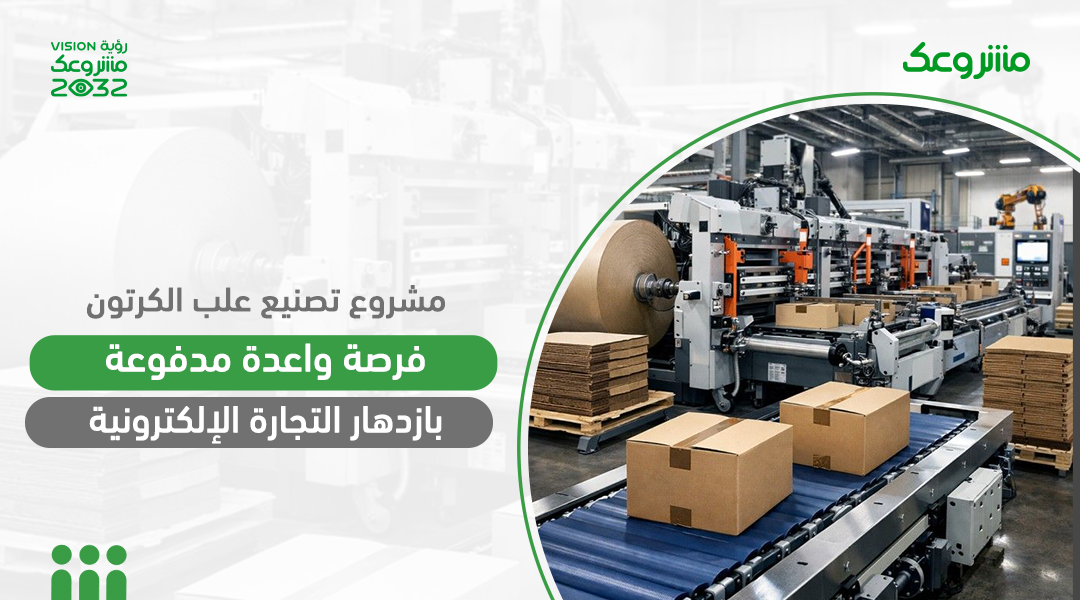
Cardboard Box Manufacturing Project: A Promising Opportunity Driven by the Growth of E-Commerce - Mashroo3k
Published10 Aug 2026 0 comments 403 Observation
Cardboard Box Manufacturing Project: A Promising Opportunity Driven by the Growth of E-Commerce

The cardboard box manufacturing project is considered one of the promising industrial ventures benefiting from the continued growth of the packaging sector, given the increasing reliance on cardboard for packaging and protecting products during transportation, storage, and display.

With the expansion of e-commerce, as well as the food and pharmaceutical industries, and the growing volume of commercial and industrial activities, the demand for cardboard products in various sizes and designs continues to increase to meet the needs of diverse sectors.

The project’s significance lies in its ability to target a broad customer base, ranging from factories and companies to retailers and small businesses. Achieving good returns, however, depends on selecting the right location, determining the appropriate production capacity, and providing highly efficient production lines, in addition to maintaining product quality, managing costs, and developing an effective marketing strategy that ensures competitiveness and the project’s long-term sustainability.

What Is a Cardboard Box Manufacturing Project?

A cardboard box manufacturing project is an industrial activity focused on converting cardboard raw materials into ready-to-use packaging, with sizes and designs tailored to the nature of different products. This includes the production of shipping and packaging boxes, food packaging, and boxes designed for clothing, appliances, and consumer products.

The process begins with preparing the raw materials, followed by cutting, forming, printing, and assembling them using specialized equipment, with the option to produce customized designs and printing according to customer requirements.

The project is characterized by the wide range of applications for its products and its ability to serve various sectors. The factory can also gradually expand by adding new production lines, increasing production capacity, and developing designs, helping to build a diverse customer base and strengthen its competitiveness in the market.

Cardboard Recycling Project: A Green Investment with Sustainable Returns

Is a Cardboard Box Manufacturing Project Profitable?

Yes, a cardboard box manufacturing project (corrugated and paperboard) is considered a promising industrial investment opportunity with high economic feasibility, driven by the rapid growth of the retail, e-commerce, and logistics sectors, which are increasing demand for sustainable and reliable packaging solutions.

Reliable market data confirms the strength of this sector, with the corrugated and paperboard boxes market valued at approximately USD 247.45 billion in 2026. Studies expect this upward momentum to continue, with the total market size projected to reach USD 302.82 billion by 2031, registering a compound annual growth rate (CAGR) of 4.12% over the forecast period.

Why Is Cardboard Box Manufacturing a Promising Investment Opportunity?

  • Consistently high demand for cardboard boxes from factories, companies, and e-commerce stores across various sectors.
  • A diverse customer base, as the project serves the food, pharmaceutical, cosmetics, clothing, electronics, and other sectors.
  • Good investment returns due to growing demand and recurring customer purchases.
  • Easy scalability by increasing production lines or adding new types and sizes of boxes.
  • Benefiting from the growth of e-commerce, which relies heavily on cardboard packaging for shipping and delivery operations.
  • Producing a variety of designs and sizes to meet different customer needs and enhance competitiveness.
  • Using recyclable raw materials in line with modern trends toward sustainable packaging.
  • Ease of entering into long-term supply contracts with companies and factories, ensuring sales stability.
  • The ability to provide printing and customization services to add competitive value and increase profit margins.
  • Reduced waste rates when using modern production equipment and efficient operating systems.
  • Strong opportunities for expansion into local and export markets as demand for packaging products increases.
  • Flexibility in developing products to meet market requirements and changing customer needs.

Read here: Why Is a Cardboard Project Considered One of the Best Industrial Projects in 2026?

Market Study for a Cardboard Box Manufacturing Project

  • Analyzing the demand for cardboard boxes across various industrial and commercial sectors.
  • Identifying target segments such as food and pharmaceutical factories, e-commerce companies, and manufacturing facilities.
  • Studying competitors in terms of product quality, pricing, production capacity, and strengths and weaknesses.
  • Analyzing market trends and identifying the growing demand for environmentally friendly and recyclable packaging.
  • Identifying market gaps that can be leveraged by offering distinctive products or services.
  • Studying prevailing prices for products and raw materials to ensure a competitive pricing policy.
  • Evaluating suitable distribution channels to efficiently reach target customers.
  • Forecasting sales volume based on production capacity and demand in the target market.

Costs of a Cardboard Box Manufacturing Project and Factors Affecting Them

  • The cost of purchasing or leasing the factory according to the required location and space.
  • The cost of production lines and equipment based on the level of automation and production capacity.
  • The cost of raw materials such as cardboard sheets, inks, and adhesives.
  • The costs of licenses and permits required to legally operate the project.
  • Infrastructure costs, including electrical work, ventilation, and internal facilities.
  • Labor and operating costs, including wages, training, and insurance.
  • Periodic maintenance costs to maintain the efficiency of equipment and production lines.
  • Transportation and distribution costs for delivering products to customers and target markets.
  • Marketing and sales costs to build a customer base and increase product reach.
  • Working capital to cover daily expenses during the initial stages of project operation.

Equipment and Production Line for a Cardboard Box Manufacturing Project

  • Cardboard Sheet Feeder: Transfers raw materials to the various manufacturing stages.
  • Printing Machine: Prints logos, information, and designs on cardboard boxes.
  • Die-Cutting Machine: Cuts cardboard sheets according to the required sizes and shapes.
  • Creasing and Perforating Machine: Prepares folding lines and facilitates box forming.
  • Gluing Machine: Assembles and closes boxes accurately and quickly.
  • Forming and Folding Machine: Produces boxes in their required final shape.
  • Air Compressor: Operates equipment that relies on compressed air.
  • Conveyor Belts: Facilitate the movement of products between different production stages.
  • Inspection and Quality Control Equipment: Ensures that products meet the required specifications.
  • Final Packaging and Packing Equipment: Prepares boxes for storage or shipment.

Steps to Implement a Cardboard Box Manufacturing Project

  • Conducting a comprehensive feasibility study to assess demand, costs, expected returns, and investment viability.
  • Identifying target products and selecting the types and sizes of cardboard boxes that meet market needs.
  • Selecting a suitable factory location that meets operational requirements and facilitates production and distribution.
  • Obtaining the necessary licenses and permits to operate the business in accordance with applicable regulations and requirements.
  • Purchasing production lines and equipment that match the targeted production capacity and required product quality.
  • Contracting with raw material suppliers to ensure the availability of high-quality cardboard sheets and materials at suitable prices.
  • Hiring and training technical and administrative staff to operate equipment and implement quality standards.
  • Preparing the factory, operating the production line, and conducting operational tests to ensure equipment efficiency and product quality.
  • Developing an effective marketing plan to target customers and build a strong distribution network within the target markets.
  • Continuously monitoring performance and development by maintaining quality control, analyzing operating results, and improving production in line with market requirements.

Read here: How to Start a Cardboard Baler Project and Manage It Successfully Until the Sales Stage?

Key Products of a Cardboard Box Manufacturing Project

  • Corrugated cardboard boxes used for shipping, storage, and transporting goods.
  • Food packaging boxes for dry and frozen foods and baked goods.
  • Pharmaceutical and medical supplies boxes designed in accordance with required quality standards.
  • Cosmetics and perfume boxes featuring attractive shapes and designs that enhance brand identity.
  • Boxes for electronic and electrical appliances to protect products during transportation and storage.
  • Clothing and footwear boxes used by retail stores and brands.
  • Luxury gift boxes featuring high-quality printing and finishing.
  • E-commerce boxes designed specifically for packaging and shipping orders to customers.
  • Fruit and vegetable boxes used for packaging and transportation in local and export markets.
  • Spare parts and industrial product boxes in various sizes suitable for the nature of the products.
  • Internal cardboard dividers to protect fragile products inside packaging.
  • Custom-printed cardboard packaging featuring company logos and brand identities.

Marketing Methods for Cardboard Box Manufacturing Products

  • Direct contracting with factories and companies that require cardboard boxes on a regular basis.
  • Targeting e-commerce companies to provide shipping and packaging boxes in various sizes.
  • Creating a professional website showcasing products, printing and customization services, and contact information.
  • Marketing through social media platforms to showcase work samples and reach potential customers.
  • Participating in industrial and commercial exhibitions to promote products and build new partnerships.
  • Collaborating with packaging companies and industrial product suppliers to expand the customer base.
  • Offering competitive quotations and discounts for contracts and large-volume orders.
  • Providing customized design and printing services featuring customers’ logos and brand identities.
  • Leveraging digital marketing and search engine optimization to attract customers looking for cardboard box suppliers.
  • Building a network of distributors and agents to expand market reach.
  • Focusing on after-sales service and fast order fulfillment to retain existing customers and acquire new ones.
  • Encouraging customer referrals by providing high-quality products at suitable prices and adhering to delivery schedules.

How Does a Feasibility Study Contribute to the Success of a Cardboard Box Manufacturing Project?

  • Analyzing demand for cardboard boxes and identifying available market opportunities.
  • Accurately estimating investment and operating costs before launching the project.
  • Determining the appropriate production capacity based on market size and available budget.
  • Selecting the optimal location to facilitate production and distribution operations.
  • Identifying the appropriate equipment and production lines for the targeted products.
  • Analyzing competitors and studying their strengths and weaknesses to build a competitive advantage.
  • Developing an effective marketing strategy to reach target customers and increase sales.
  • Estimating expected revenues and profits and calculating the project’s financial feasibility indicators.
  • Identifying potential risks and developing practical solutions to minimize their impact.
  • Helping attract investors and financing institutions by presenting a professional business plan supported by data and analysis.

Also read: Feasibility Study: Its Importance, How to Prepare It, and How to Conduct a Feasibility Study

How to Choose the Most Suitable Location for a Cardboard Box Manufacturing Project

  • Proximity to target customers to reduce transportation costs and ensure fast order fulfillment.
  • Easy access to raw material suppliers to ensure production continuity without delays.
  • Availability of sufficient space to accommodate production lines, storage areas, and future expansion.
  • Availability of essential utilities such as electricity, water, ventilation, drainage, and telecommunications networks.
  • Easy access for trucks to facilitate the transportation of raw materials and finished products.
  • Selecting an industrial area that is suitable for the nature of the activity and facilitates obtaining the necessary licenses.
  • Considering rental or purchase costs in line with the budget allocated to the project.
  • Availability of technical labor near the factory location to facilitate recruitment and operations.
  • Compliance with environmental and industrial requirements to avoid future legal obstacles.
  • The possibility of future expansion by adding production lines or additional storage space as business volume increases.

Potential Risks in a Cardboard Box Manufacturing Project and How to Overcome Them

Potential RisksHow to Overcome Them
Rising raw material pricesContracting with multiple suppliers and building a strategic inventory when prices are stable.
Declining demand during certain periodsDiversifying the customer base and expanding into new sectors and markets.
Production line and equipment breakdownsConducting regular equipment maintenance and keeping essential spare parts available to minimize downtime.
Delays in raw material supplyWorking with reliable suppliers and developing contingency plans to secure production requirements.
Rising operating costsImproving resource efficiency, reducing waste, and optimizing energy consumption.
Product quality issuesImplementing a quality control system across all production stages and ensuring that products meet required specifications.
Delayed order deliveriesDeveloping an accurate production plan and order schedule, while maintaining adequate inventory of the most in-demand products.
Changes in market requirementsContinuously monitoring market trends and developing products in line with customer needs.

My Experience with a Cardboard Box Manufacturing Project

When I started my cardboard box manufacturing project, I was certain that demand for packaging products in the Kingdom of Saudi Arabia was continuously growing, particularly with the expansion of the industrial, commercial, and e-commerce sectors. However, turning this opportunity into a successful project was not easy. Initially, I faced several challenges, most notably difficulty in properly planning the project, uncertainty regarding the appropriate investment size, selecting suitable production lines, and determining the production capacity that would align with market needs. In addition, there were technical challenges related to selecting the right raw materials, improving the efficiency of cutting, printing, forming, and gluing processes, reducing production waste, and establishing an effective quality control system.

At that point, I sought the expertise of the consultants at Mashroo3k Consulting, who prepared a professional feasibility study that provided me with a clear overview of all project stages and how to operate it efficiently. The team also helped me address technical challenges, select the appropriate equipment, and optimize production processes to ensure product quality and improve operational efficiency.

Their support did not stop there. They also assisted me in preparing the financing application, enabling me to secure funding from the Saudi Industrial Development Fund. This provided the liquidity needed to implement the project according to the established plan.

Thanks to the expertise and support provided by the consultants at Mashroo3k Consulting, the factory now operates more efficiently, its production capacity has increased, and it is able to meet the growing demand in the Saudi market while maintaining competitive quality.

Frequently Asked Questions About a Cardboard Box Manufacturing Project

How Much Does a Cardboard Factory Cost?

The cost of a cardboard factory depends on the project size, production capacity, type of production lines, and level of facilities required. Therefore, there is no fixed figure that applies to all projects. Costs typically include equipment, factory setup, raw materials, labor, licenses, and working capital. Accurately determining the cost requires a financial study that identifies the project’s requirements based on its objectives and targeted production volume.

Is the Cardboard Box Business Profitable?

Yes, the cardboard box business is considered profitable due to the high demand for these products across multiple sectors, including food industries, pharmaceuticals, e-commerce, and shipping and storage companies. Profitability opportunities increase when high-quality products are offered at competitive prices, delivery schedules are maintained, and long-term customer relationships are established, ensuring stable sales and a higher return on investment.

Is a Cardboard Factory Profitable?

Yes, a cardboard factory is considered a profitable industrial project due to the continuous demand for its products from factories, retailers, shipping companies, and e-commerce businesses. The potential for higher profits increases when high-quality products are offered, production is diversified to meet customer needs, operational efficiency is maintained, waste is minimized, and ongoing supply contracts are established with companies, contributing to stable sales and a good return on investment.

How Do I Open a Cardboard Factory?

To open a cardboard factory, start by determining the types of products you want to manufacture and the appropriate production capacity. Then, equip the factory with the necessary machinery and production lines and obtain the required licenses. Contract with reliable raw material suppliers and provide a qualified team to operate the equipment. After that, begin trial production to ensure product quality and operational efficiency, then gradually expand your supply operations to factories, companies, and retailers according to your production capacity.

What Licenses Are Required to Start a Cardboard Box Manufacturing Project?

The licenses required to start a cardboard box manufacturing project vary from one country to another. However, they typically include obtaining a commercial registration, an industrial activity license, a tax card, registration with the relevant authorities, and approvals related to occupational safety, health, and environmental requirements, in addition to any other permits required by local authorities. It is recommended to verify all regulatory requirements in the country where the project will be implemented before commencing operations.

In Conclusion: Cardboard Box Manufacturing Project

In light of the continued growth of the packaging sector, cardboard manufacturing stands out as one of the industrial projects offering promising investment opportunities, thanks to its diverse applications and sustained demand across various sectors.

However, success in this field depends on more than simply providing machinery and production lines. It requires accurate market analysis, sound financial and operational planning, and an effective marketing strategy that ensures access to target customers.

Therefore, preparing a comprehensive feasibility study represents the first step toward building a competitive project capable of achieving sustainable returns.

Contact Us to request a feasibility study for a cardboard box manufacturing project.


Similar Articles

How to Turn a Kebab Restaurant Project into a Distinctive Brand in Egypt?

The kebab restaurant project is one of the food-service ventures that combines strong demand for grilled meals with the opportunity to target a diverse customer base, including individuals, families, and lovers of traditional Middle Eastern cuisine. With growing competition in the restaurant sector, however, the project’s success is no longer determined by food taste alone. […]

Read more

Children’s Play Center Project in Saudi Arabia: How to Create an Experience That Attracts Children and Families?

A children’s toy store project is not limited to selling toys; it is built on understanding what attracts children and what families look for when choosing products that combine entertainment and educational value. With the wide variety of educational toys, skill-development games, recreational toys, and gifts available, the store has opportunities to meet the needs […]

Read more

Residential Complex Project in Saudi Arabia: An Investment That Creates Value Beyond Residential Units

A residential complex project is no longer simply an investment in a collection of real estate units. It has evolved into an integrated development model that combines comfortable living, diverse services, and long-term investment value. As cities expand and residents’ needs evolve, demand is growing for residential complexes that offer a comprehensive environment suited to […]

Read more

Veterinary Clinic Project in Egypt: A Promising Investment Opportunity in the Animal Care Sector

The veterinary clinic project comes at a time when animal care is no longer limited to treating illnesses or injuries, but has expanded to include health monitoring, vaccinations, routine checkups, and care for both pets and livestock. However, many animal owners face challenges in accessing specialized veterinary services that combine prompt response, high-quality care, and […]

Read more

Green Friday

فرصة لا تتكرر

GREEN FRIDAY

خصم 25% على خدمات مشروعك استفد من العرض الآن، فالفرصة متاحة لفترة محدودة فقط
سجّل بياناتك واحصل على خصم 25% الآن