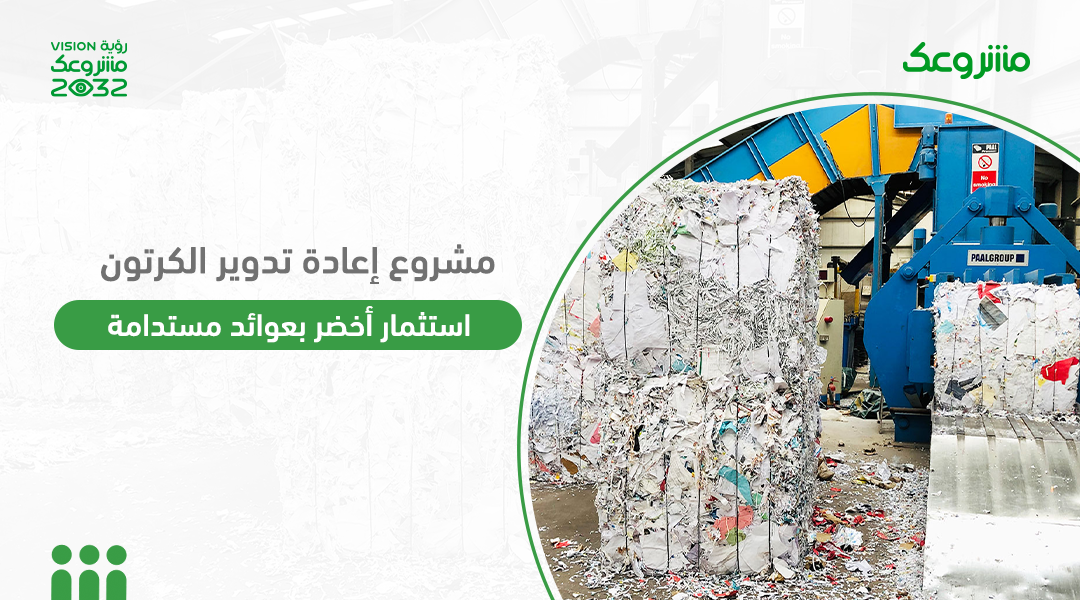
With the global acceleration towards a green economy and the establishment of sustainability concepts, the cardboard recycling project emerges as a unique investment opportunity that combines economic feasibility with a positive environmental impact. Cardboard is an essential part of our daily lives, and recycling it not only reduces pollution but also preserves natural resources and creates new income sources for investors. This project provides a real opportunity to achieve long-term financial and environmental sustainability by transforming waste into usable and resellable products, while opening continuous growth prospects in the market. In this article, we reveal the precise steps for establishment and the key success factors, enabling your investment to become a model of sustainable profit and positive impact.
The cardboard recycling project is an industrial activity aimed at collecting used cardboard waste from markets and factories, and then converting it through processes of sorting, washing, shredding, and re-manufacturing into raw materials or new products such as cardboard, packing boxes, or various packaging products. This project is considered an important environmental solution to reduce waste accumulation, preserve natural resources, while at the same time providing a profitable economic opportunity through the production of materials that can be sold and used industrially.
Yes, the cardboard recycling market is witnessing significant growth, which enhances profitability opportunities for any new project in this sector. Forecasts indicate that the market size will increase from USD 55.31 billion in 2025 to USD 59.71 billion in 2026, at a compound annual growth rate of 8%. Looking ahead, the market is expected to continue its growth, reaching USD 80.41 billion by 2030, with a compound annual growth rate of 7.7%, reflecting the increasing demand for recycled cardboard and indicating that investing in this project has promising and sustainable long-term profitability prospects.
Equipment and Machinery Required to Start a Cardboard Recycling Project
What is the cost of a cardboard recycling project?
The cost of a cardboard recycling project varies depending on the project size, production capacity, and geographic location. However, it is generally divided into several main components, the most important of which are:
1. Capital Costs (Initial Investment)
2. Operational Costs (Ongoing Expenses)
3. Marketing and Administrative Costs
The executive summary serves as the first gateway to understanding the cardboard recycling project, providing a comprehensive and concise overview that covers the main aspects of the project, including its objectives, required investment size, and expected financial returns. This section enables the investor to quickly assess the project’s feasibility and understand its profitability and competitiveness, as well as its strategic position within the value chain of the recycling and environmental industries. Therefore, the executive summary is considered an essential step before delving into the details of the full study, due to its pivotal role in making investment decisions.
This section provides a detailed overview of the nature of the activity, outlining the scope of production and services that the project will offer, most notably the collection, sorting, and cutting of used cardboard and converting it into raw materials ready for reuse. It also highlights the project’s capability to meet the needs of factories and companies that consume recycled paper and cardboard, while adhering to the highest standards of quality and environmental cleanliness. The section specifies the essential resources required to operate the project, such as equipment (cutting and pressing machines), storage spaces, qualified technical staff, and suitable infrastructure, which helps the investor form a clear understanding of the workflow and production stages.
The market study relies on analyzing the increasing demand for recycled cardboard, along with examining competitors, price levels, and the behavior of target customers from packaging factories and industrial companies. The analysis includes preparing a SWOT to assess internal strengths and weaknesses, in addition to external opportunities and threats that may affect the project. This analysis provides the investor with an accurate understanding of market dynamics, identifies promising opportunities, and estimates future revenues precisely, ensuring that the project is designed to efficiently meet market needs and build a sustainable competitive advantage.
Read here: Why is market research considered an essential tool for business success?
The technical study focuses on the operational aspects of the project, including the identification of the required equipment and technologies, selecting the most suitable location in terms of proximity to sources of used cardboard and markets, as well as determining the project’s needs for raw materials and qualified technical labor. The study also includes planning and designing the factory site, encompassing sorting units, cutting machines, storage facilities, ventilation systems, and health and environmental measures. This design aims to ensure the production of high-quality recycled cardboard with excellent operational efficiency, while minimizing waste and losses as much as possible.
Read also: 7 key elements of a technical feasibility study for projects
The financial study outlines the establishment and operational costs, required capital, expected revenues, breakeven point, and capital recovery period. By analyzing fixed and variable costs and net profits, the investor can accurately assess the project’s profitability and make an informed investment decision, as this section links practical capabilities with economic feasibility.
Also read: The importance of having a financial feasibility study for your investment project
The marketing study focuses on developing a strategic plan to efficiently deliver the project’s products to customers. This includes identifying the ideal market, analyzing the target customer segments from packaging factories, and selecting appropriate distribution channels, whether directly or through agents and distributors. It also addresses sales mechanisms and promotional strategies, such as digital marketing, public relations, and participation in industrial exhibitions, in addition to competitive pricing policies. This section aims to build a strong bridge between production and actual market demand, ensuring maximum sales and enhancing market share, thereby positively impacting financial returns and sustainable project growth.
Read also: Its Definition, Importance, Preparation Method, and Key Tools
This section addresses the licenses and official approvals required from the competent governmental authorities, such as the Ministry of Environment or municipalities, in addition to compliance with local laws related to recycling and environmental and health standards. Adherence to these regulations contributes to protecting the project from legal risks and fines, and enhances its credibility with clients and partners, ensuring the continuity of operations within a legally safe environment.
Read here: How a Legal Feasibility Study Ensures Success and Sustainability for Your Project
Please read here: Risk Management in Projects: What It Is, Its Importance, and How to Implement It
The study summarizes the results and highlights the strengths of the project, providing clear recommendations regarding the initiation or modification of certain aspects to enhance the chances of success. The conclusion affirms that the cardboard recycling project represents a sustainable and safe investment, offering rewarding financial returns in the long term and providing extensive opportunities for growth within the environmental and sustainable industries sector.
Also read: Feasibility study, its importance, how to prepare it, and how to conduct a feasibility study
Architectural Requirements in Industrial Areas (Light Activities)
For more information on municipal requirements for factories, click here.
Mr. S.A. always seeks to engage in entrepreneurship through a business model that combines economic viability with a positive environmental impact, as his ambition goes beyond merely achieving profit to make his project a sustainable legacy that serves both the environment and society. The turning point came when he noticed the substantial waste of cardboard in markets and industrial facilities, which led him to develop the idea of transforming this waste into an economically valuable resource through a recycling project.
Despite having a clear vision, S.A faced a challenge in securing financing, as he had the idea and the initial plan but lacked a precise mechanism to provide the capital required to launch the project. This is where Mashrouak Consulting played a role, offering comprehensive support that included preparing the funding file designated for the Saudi Industrial Development Fund, accurately determining the capital requirements, developing a realistic operational plan, and drafting financial projections to ensure the project’s attractiveness to investors.
The efforts of professional consultancy have been combined with the funding solutions of the Saudi Industrial Development Fund, which offers a variety of short-, medium-, and long-term financing options, including working capital financing, supply chain financing, project and acquisition financing, and multi-purpose financing, to enhance project growth, increase operational efficiency, and ensure business continuity effectively.
Thanks to this integration of professional consulting and careful financing, ‘S.A.’ was able to secure the necessary liquidity to launch his project with confidence. Today, after a year of operation, his vision has turned into an industrial reality; the factory operates with high efficiency, and recycled cardboard products are distributed to a wide network of companies and stores, achieving continuous profits and making a tangible contribution to reducing the carbon footprint.
“S. A” concludes his story about his journey, saying:
“Honestly, the road wasn’t easy at all, but Mashroo3k Consulting supported me with the appropriate financing for my project until my dream became a reality.”
How is cardboard recycled?
Cardboard recycling is carried out by collecting used cardboard, shredding it into small pieces, then washing and drying it. After that, it is processed to become ready for producing new products such as packaging boxes and paperboard. This process helps reduce waste and promotes sustainable use of materials.
Is the cardboard business profitable?
Yes, the cardboard business—whether collection or recycling—is considered profitable because it meets a high market demand for recycled packaging products. It is also an environmentally friendly project that attracts customers who prefer sustainable products.
How do I start a recycling project?
You can start by conducting a market study to understand demand, then selecting a suitable factory location, purchasing essential equipment, securing raw materials, hiring trained workers, and finally starting production and marketing the products to target customers.
What is the price of a ton of cardboard in Saudi Arabia?
The price of a ton of cardboard depends on its type, quality, and source, and it varies from one region to another. Therefore, it is recommended to contact local cardboard suppliers to get updated prices and ensure purchasing at suitable rates.
How do you make money from cardboard?
Profit can be generated from cardboard by collecting and selling it to recycling companies, or by establishing a project to produce recycled cardboard products and selling them, especially to packaging sectors and factories that rely on cardboard in their daily operations.
The cardboard recycling project emerges as a distinguished investment opportunity that combines economic feasibility with environmental preservation, transforming waste into a valuable resource and turning refuse into a source of real added value. The success of this project depends on a strategic vision, precise planning, and high operational efficiency, thereby providing the investor with rewarding returns and contributing to a cleaner and more sustainable environment for future generations.

For inquiries and to request a feasibility study for a cardboard recycling project
The kebab restaurant project is one of the food-service ventures that combines strong demand for grilled meals with the opportunity to target a diverse customer base, including individuals, families, and lovers of traditional Middle Eastern cuisine. With growing competition in the restaurant sector, however, the project’s success is no longer determined by food taste alone. […]
Read moreA children’s toy store project is not limited to selling toys; it is built on understanding what attracts children and what families look for when choosing products that combine entertainment and educational value. With the wide variety of educational toys, skill-development games, recreational toys, and gifts available, the store has opportunities to meet the needs […]
Read moreA residential complex project is no longer simply an investment in a collection of real estate units. It has evolved into an integrated development model that combines comfortable living, diverse services, and long-term investment value. As cities expand and residents’ needs evolve, demand is growing for residential complexes that offer a comprehensive environment suited to […]
Read moreThe veterinary clinic project comes at a time when animal care is no longer limited to treating illnesses or injuries, but has expanded to include health monitoring, vaccinations, routine checkups, and care for both pets and livestock. However, many animal owners face challenges in accessing specialized veterinary services that combine prompt response, high-quality care, and […]
Read more
خصم 25% على خدمات مشروعك استفد من العرض الآن، فالفرصة متاحة لفترة محدودة فقط
سجّل بياناتك واحصل على خصم 25% الآن


