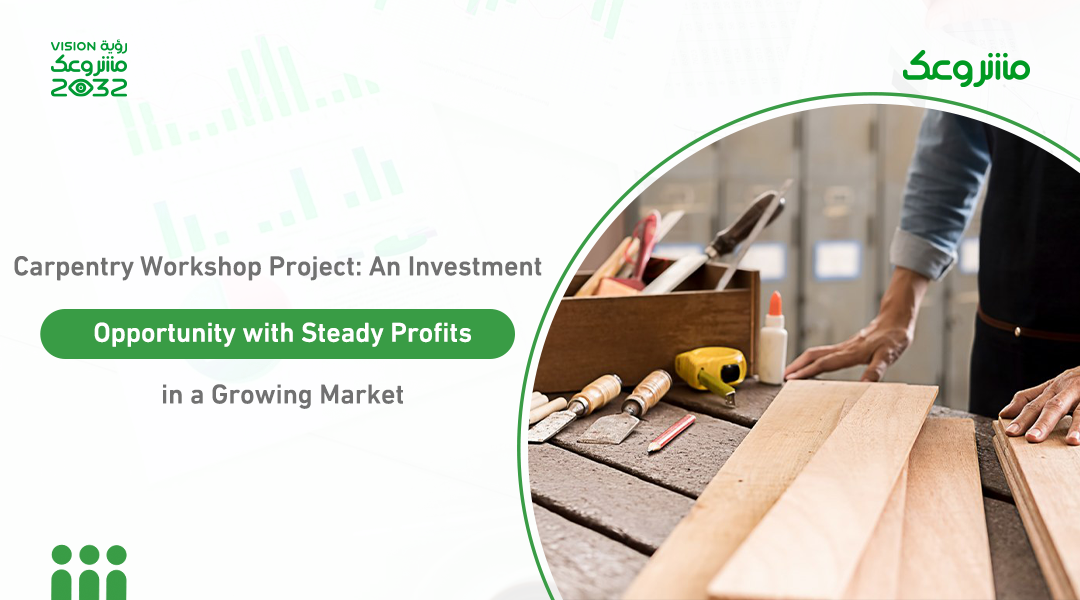
Carpentry Workshop Project: An Investment Opportunity with Steady Profits in a Growing Market - Mashroo3k
Published12 Oct 2025 0 comments 1271 Observation
Carpentry Workshop Project: An Investment Opportunity with Steady Profits in a Growing Market

Carpentry Workshop Project

A carpentry workshop is considered one of the most promising investment opportunities due to the growing demand for wood products in furniture, construction, and finishing sectors. Wood remains an essential material in daily life. The workshop’s role extends beyond manufacturing furniture, doors, and windows; it also includes precise carpentry work to meet the needs of both individuals and businesses, with the potential to develop innovative products aligned with consumer tastes and modern market trends. With careful planning and a comprehensive feasibility study covering technical, financial, and marketing aspects, a carpentry workshop can become a successful project that ensures continuous demand, generates attractive returns, supports the local economy, and creates real job opportunities for youth.

What is a Carpentry Workshop Project?

A carpentry workshop is an industrial and craft activity aimed at transforming raw wood into a variety of products that meet the needs of individuals and institutions—from home and office furniture to doors, windows, and interior decor. This project is highly flexible, as it can be implemented with varying capital levels: a small workshop serving the local market or a larger facility targeting expansion and fulfilling the demands of real estate and commercial projects. It combines artistic and creative aspects through high-quality innovative designs with an investment dimension that generates attractive financial returns due to continuous and growing demand for wooden products. Moreover, it provides employment opportunities and supports related industries, making it a strategic choice that balances economic sustainability with profitable returns.

Importance of a Carpentry Workshop Project

  • Meets the increasing demand for high-quality furniture, doors, and windows that align with consumer preferences.
  • Supports the construction and finishing sector by providing essential wooden products for residential and commercial projects.
  • Provides direct employment for youth and skilled workers and helps transfer craftsmanship knowledge across generations.
  • Ensures stable and sustainable financial returns due to consistent demand, especially amid ongoing urban growth.
  • Encourages complementary industries like paints, metal accessories, and wooden supplies, creating an integrated production network.
  • Allows gradual production expansion—from a small workshop to a full-scale facility, with potential export opportunities or collaborations with interior design offices.
  • Integrates traditional craftsmanship with modern technologies (e.g., CNC machines) for innovative and attractive designs combining heritage and modernity.
  • Supports the local economy by reducing reliance on imports and promoting small and medium enterprises (SMEs).
  • Enhances investors’ competitiveness by offering customizable wooden products tailored to customer needs and project specifications.
  • Provides wide opportunities for creativity and innovation in furniture and interior design, enriching the visual and cultural landscape.
  • Can be eco-friendly if it relies on sustainable wood sources and recycling practices.
  • Empowers artisans to turn skills into successful entrepreneurial ventures, promoting a culture of self-reliance and local entrepreneurship.

Read here: Wood Industry Market Report in the Kingdom of Saudi Arabia

Profitability of a Carpentry Workshop

The woodworking market is growing rapidly, with a notable market size increase from $72.56 billion in 2024 to $76.07 billion in 2025, reflecting a CAGR of 4.8%. Future projections anticipate accelerated growth, reaching $93.54 billion by 2029 at a CAGR of 5.3%. These indicators confirm that a carpentry workshop is not merely a traditional craft but a promising investment capable of generating sustainable profits due to rising demand for furniture, doors, windows, and decorative wooden elements across residential and commercial sectors.

Read here: Wood Recycling – A Profitable Project with Guaranteed Investment Returns

How to Start a Carpentry Workshop

  1. Prepare a comprehensive feasibility study for a well-informed investment decision.
  2. Choose a strategic location with easy access for customers and suppliers, adequate space, good ventilation, and proper lighting.
  3. Obtain all required legal licenses and permits to operate lawfully.
  4. Design the workshop layout: separate areas for cutting, assembly, finishing, and storage, with effective sound insulation.
  5. Purchase essential machinery based on project size: band saws, circular saws, CNC routers, drills, air presses, and precise hand tools.
  6. Partner with reliable suppliers for high-quality wood, considering price, quality, and sustainability.
  7. Hire a skilled team of carpenters and assistants, and provide regular training on modern techniques and safety.
  8. Develop a smart marketing plan combining digital presence and field marketing.
  9. Open a dedicated business bank account and use simple accounting software to track expenses, revenues, and profitability.
  10. Focus on quality and innovation, offering customizable designs using software like SketchUp or AutoCAD to present ideas to clients.
  11. Conduct regular preventive maintenance of machinery and provide personal protective equipment for workers.
  12. Plan for expansion through new production lines, installation services, or local exports.
  13. Follow eco-friendly practices, like using wood shavings for pellets or compost and avoiding harmful paint residues.

Read here: Why Feasibility Studies Are a Game-Changer for Your Project?

Also read: How Feasibility Studies Affect Your Business Profitability and Sustainability

Costs of a Carpentry Workshop

Initial Costs:

  • Renting or purchasing a suitable location.
  • Construction and interior setup.
  • Purchasing machinery and essential tools.
  • Licensing and legal permits.

Operational Costs:

  • Raw materials (wood, plywood, adhesives, other supplies).
  • Employee salaries.
  • Electricity bills for machinery.
  • Regular maintenance costs.

Additional Costs:

  • Worker insurance and health coverage.
  • Transportation of raw materials and finished products.
  • Waste disposal or recycling.
  • Worker training on modern tools and techniques.
  • Budget for product development and tool upgrades.

Other Items:

  • Screws, hinges, paints, varnishes.
  • Initial advertising campaigns.
  • Ongoing utilities (water, electricity, etc.).

Requirements to Open a Carpentry Workshop

  • Minimum site area of 100 m²; building coverage not exceeding 55%.
  • Front setback of 6 meters (rear and side not applicable).
  • Workshop height: 7.5 m to 30 m.
  • Minimum of 2 parking spots, one per 50 m² of total building area.
  • Maximum 30% of the workshop area may be used as office space.
  • No worker accommodation allowed on-site.
  • Compliance with Saudi Building Code and relevant standards.
  • Fire safety systems and flame prevention measures.
  • Prohibition of flammable or harmful materials like asbestos.
  • Clear emergency exits; no equipment or machinery obstructing paths.
  • Provide first aid equipment with visible signage.

For more information on the requirements for a carpentry workshop project in Saudi Arabia, click here

Tools and Equipment Needed

  • Measuring Tape: For precise wood measurements.
  • Spirit Level: To ensure horizontal and vertical accuracy.
  • Square Ruler: For accurate 90° angles.
  • Compass: For circles, arcs, and decorative curves.
  • Hand Saw: For thin wood or precision cuts.
  • Electric Saw: For fast cutting of thicker wood.
  • Hammer: For fastening or removal.
  • Screwdrivers: For assembly of various screws.
  • Drill: For precise holes and screw insertion.
  • Hand Plane: For smoothing edges.
  • Wood File: For finishing edges.
  • Thicknesser Machine: To adjust board thickness.
  • Safety Glasses: Eye protection from dust and debris.
  • Gloves: Hand protection from cuts and splinters.
  • Workbench: Stable surface for cutting and assembly.
  • Air Blower: For cleaning sawdust and maintaining workshop cleanliness.
  • Manual Wrenches: For handling fasteners and metal fittings.

To contact us and request a feasibility study for a carpentry workshop project


Similar Articles

How to Turn a Kebab Restaurant Project into a Distinctive Brand in Egypt?

The kebab restaurant project is one of the food-service ventures that combines strong demand for grilled meals with the opportunity to target a diverse customer base, including individuals, families, and lovers of traditional Middle Eastern cuisine. With growing competition in the restaurant sector, however, the project’s success is no longer determined by food taste alone. […]

Read more

Children’s Play Center Project in Saudi Arabia: How to Create an Experience That Attracts Children and Families?

A children’s toy store project is not limited to selling toys; it is built on understanding what attracts children and what families look for when choosing products that combine entertainment and educational value. With the wide variety of educational toys, skill-development games, recreational toys, and gifts available, the store has opportunities to meet the needs […]

Read more

Residential Complex Project in Saudi Arabia: An Investment That Creates Value Beyond Residential Units

A residential complex project is no longer simply an investment in a collection of real estate units. It has evolved into an integrated development model that combines comfortable living, diverse services, and long-term investment value. As cities expand and residents’ needs evolve, demand is growing for residential complexes that offer a comprehensive environment suited to […]

Read more

Veterinary Clinic Project in Egypt: A Promising Investment Opportunity in the Animal Care Sector

The veterinary clinic project comes at a time when animal care is no longer limited to treating illnesses or injuries, but has expanded to include health monitoring, vaccinations, routine checkups, and care for both pets and livestock. However, many animal owners face challenges in accessing specialized veterinary services that combine prompt response, high-quality care, and […]

Read more

Green Friday

فرصة لا تتكرر

GREEN FRIDAY

خصم 25% على خدمات مشروعك استفد من العرض الآن، فالفرصة متاحة لفترة محدودة فقط
سجّل بياناتك واحصل على خصم 25% الآن