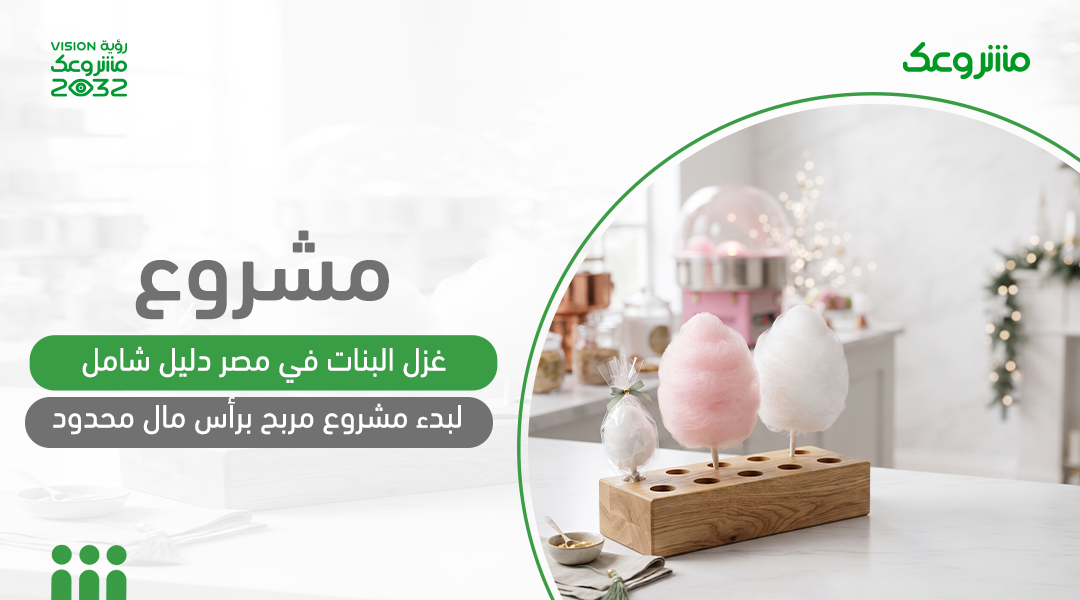
Cotton Candy Business in Egypt: A Comprehensive Guide to Starting a Profitable Business with Limited Capital - Mashroo3k
Published12 Aug 2026 0 comments 64 Observation
Cotton Candy Business in Egypt: A Comprehensive Guide to Starting a Profitable Business with Limited Capital

A cotton candy business is one of the small businesses that combines low operating costs with strong demand, particularly in parks, shopping malls, events, festivals, and various entertainment venues. The business is relatively easy to set up and can offer a quick return on investment when managed properly, making it a suitable option for those looking to start a business with limited capital.
However, success does not depend solely on owning a cotton candy machine. It requires careful market research, selecting the right location, and developing an effective operational and marketing plan to attract customers and generate sustainable profits. In this article, we cover everything you need to establish a cotton candy business, from requirements and costs to success factors and the best ways to increase profitability.

What Is a Cotton Candy Business?

A cotton candy business is a small commercial venture that involves producing and selling cotton candy using a specialized machine that transforms sugar into soft, cotton-like strands, which are then wrapped around wooden sticks or packaged in cups and containers. The business targets various age groups, particularly children and families, and typically attracts strong demand in parks, shopping malls, schools, festivals, and entertainment events.
The business is relatively easy to operate and has lower operating costs compared with many other businesses. It can also be established at a fixed location or operated through a mobile cart, giving investors greater flexibility in reaching customers and increasing sales opportunities. Products can also be diversified by offering different colors and flavors or presenting cotton candy in creative designs suitable for various occasions and celebrations, helping strengthen the business’s competitiveness and increase revenue.

Read More: Dessert Sales Project: A Profitable Business Idea with Flexible Capital

Is a Cotton Candy Business Profitable?

Market indicators point to promising growth opportunities for a cotton candy business. The global cotton candy market was valued at approximately USD 2.05 billion in 2026 and is projected to reach USD 3.37 billion by 2035, growing at a compound annual growth rate (CAGR) of approximately 5.67% from 2026 to 2035. This reflects continued demand for the product and favorable opportunities for business growth and attractive returns when the right location is selected and costs and marketing are managed efficiently.

Advantages of Investing in a Cotton Candy Business

  • Lower startup costs compared with many food and confectionery businesses.
  • Easy to operate without requiring a large space, particularly when using a cart or kiosk.
  • Relatively low raw material costs, which can help achieve a good profit margin.
  • High demand for cotton candy in parks, festivals, and entertainment venues.
  • Easy product diversification by offering different flavors, colors, and sizes.
  • The ability to target children, families, event visitors, and customers attending various occasions.
  • Flexibility in selecting sales locations based on customer traffic and demand levels.
  • Easy promotion through social media platforms and attractive offers.
  • Opportunities for future expansion by adding more carts or new sales points in different locations.
  • سرعة إعداد المنتج وتقديمه، مما يساعد على خدمة عدد أكبر من العملاء خلال فترات الذروة.

What Is the Cost of a Cotton Candy Business in Egypt?

The cost of a cotton candy business varies depending on the project’s size, the type of cotton candy machine, the operating location, and the required setup and equipment. Several key factors affect the overall cost, including:

  • The type of cotton candy machine, whether manual, semi-automatic, or fully automatic.
  • Project site setup, such as a kiosk, shop, or mobile cart, in addition to decorations, signage, and display equipment.
  • The cost of raw materials, including sugar, food coloring, flavorings, wooden sticks, and packaging bags or containers.
  • Licensing and permit fees, which vary depending on the country, type of business activity, and project location.
  • Labor costs, if the business requires employees to operate the equipment or manage sales.
  • Operating expenses, such as electricity, routine maintenance, transportation, and marketing.
  • Marketing campaign expenses, whether through social media platforms or participation in events and festivals.

Essential Equipment and Setup for a Cotton Candy Business

  • A cotton candy machine with specifications suitable for the targeted production capacity.
  • A sales cart, kiosk, or shop equipped to serve customers and display products.
  • A generator or stable power source to ensure efficient machine operation.
  • Packaging containers and bags in various sizes to maintain product quality and make it easy to carry.
  • Wooden sticks specifically designed for serving cotton candy.
  • Airtight containers for storing sugar and raw materials away from moisture.
  • Approved food coloring and flavorings to produce a variety of options that attract customers.
  • A worktable and storage shelves to organize equipment and raw materials during operation.
  • An advertising sign and visual identity displaying the business name and attracting the attention of passersby.
  • Cleaning and sanitization equipment to maintain the cleanliness of the machine and work area.
  • A cash register or point-of-sale (POS) system to facilitate payments and manage sales.
  • Appropriate lighting to highlight the product, especially during evening operations or at events.

How to Choose the Right Location for a Cotton Candy Business

Choosing the right location is one of the most important factors in the success of a cotton candy business, as it directly affects sales volume and customer traffic. To achieve the best results, the following criteria should be considered:

  • Choose a location with high visitor traffic, such as public parks, shopping malls, amusement parks, and entertainment venues.
  • Operate near the target audience, particularly children and families, who represent the largest customer segment.
  • Take advantage of events and festivals, where demand for cotton candy tends to increase during celebrations and special occasions.
  • Ensure easy access to the location, with sufficient space for customers to stop without obstructing movement.
  • Assess the level of competition and choose a location with fewer vendors or a clear competitive advantage.
  • Ensure the availability of essential utilities, such as electricity and water if the business operates from a fixed location.
  • Obtain the required licenses and ensure that the location complies with local regulations.
  • Choose a highly visible location that attracts the attention of passersby and increases impulse purchases.
  • Consider the location’s operating costs, such as rent or event participation fees, in line with the project’s budget.
  • Consider future expansion opportunities, whether by adding new equipment or increasing the display area as the business grows.

Ways to Expand a Cotton Candy Business and Increase Profits

  • Add a variety of flavors, colors, and sizes to meet the preferences of different customer segments.
  • Offer attractive customized packaging for occasions, holidays, birthdays, and events.
  • Expand sales by operating multiple carts or kiosks in high-traffic locations.
  • Participate in festivals, entertainment events, and special occasions to reach a larger number of customers.
  • Provide cotton candy preparation and supply services for parties, schools, and private events.
  • Add complementary products such as popcorn and light sweets to increase the average order value.
  • Launch promotional offers and packages combining multiple products at an attractive price to increase sales volume.
  • Use social media platforms to promote products, showcase them attractively, and encourage customer orders.
  • Build a distinctive brand through a consistent design for the cart, packaging, and display materials.

How a Feasibility Study Can Help You Succeed with a Cotton Candy Business

  • Analyze market demand and identify available investment opportunities.
  • Identify target customer segments, their needs, and purchasing behavior.
  • Estimate the required investment and accurately determine startup and operating costs.
  • Calculate expected revenues and profits and assess the project’s financial feasibility.
  • Select the most suitable location to achieve higher customer traffic and sales.
  • Determine the equipment and raw materials required based on the targeted project size.
  • Analyze competitors and identify their strengths and weaknesses.
  • Develop an effective operating plan that ensures production efficiency and service quality.
  • Prepare a marketing strategy to attract customers and increase sales.
  • Identify potential risks and develop practical solutions to address them before implementation.
  • Develop a future expansion plan that aligns with growing demand and increasing profits.
  • Enhance financing opportunities by providing a professional feasibility study that demonstrates the project’s viability to investors and financing institutions.

Financial Indicators That Determine the Success of a Cotton Candy Business

Financial indicators reflect the performance of a cotton candy business and its ability to generate profits and remain competitive in the market. Key indicators include:

  • Increased monthly revenues as a result of higher sales volume and attracting more customers.
  • Achieving a good profit margin by controlling production and operating costs.
  • Maintaining a low unit production cost compared with its selling price in the market.
  • Recovering the initial investment within an appropriate period.
  • Maintaining stable cash flows to ensure regular coverage of operating expenses.
  • Increasing net profits over time as a result of improved operational performance.
  • Increasing inventory turnover and reducing raw material waste.
  • Reducing operating expenses as a percentage of total revenues.
  • Reaching the break-even point early and moving into the profitability stage.
  • Improving return on investment (ROI), reflecting efficient use of capital.
  • The ability to finance expansion through generated profits without relying entirely on external financing.
  • Maintaining sales growth across different seasons while keeping profits stable.

How to Manage a Cotton Candy Business

  • Develop a clear operating plan that defines daily workflows and required objectives.
  • Use high-quality raw materials to ensure a product that satisfies customers.
  • Maintain the cleanliness of the machine and sales area to preserve product quality and build customer trust.
  • Manage inventory efficiently to ensure sufficient raw materials without waste or shortages that could disrupt operations.
  • Monitor costs and revenues regularly to evaluate performance and improve profitability.
  • Set competitive prices that provide an appropriate profit margin and suit the target market.
  • Train employees to operate the machine properly and interact professionally with customers.
  • Provide fast and organized service to reduce waiting times and increase sales volume.
  • Diversify products by offering different flavors, colors, and sizes to meet customer needs.
  • Run ongoing marketing campaigns through social media and participate in events.
  • Listen to customer feedback and use it to improve products and services.
  • Perform regular equipment maintenance to prevent breakdowns and ensure efficient and continuous operations.

Read here: How to Start a Small Business and Ensure Its Profitability in 2026

Read here: Cupcake Business: Practical Steps to Build a Successful Brand

SWOT Analysis of a Cotton Candy Business

Strengths

  • Low capital required to start the business.
  • Low operating and raw material costs.
  • High profit margin compared with production costs.
  • Easy to operate and manage.
  • The ability to operate from a fixed shop or a mobile cart.
  • High demand during occasions and entertainment events.

Weaknesses

  • Sales are affected by seasons and holidays.
  • Heavy dependence on the choice of sales location.
  • Limited variety of the core product.
  • The possibility of machine breakdowns affecting business operations.
  • The need to maintain consistent product quality.

Opportunities

  • Expanding by opening new sales points.
  • Participating in festivals and public events.
  • Offering innovative flavors, colors, and shapes.
  • Partnering with party and birthday event organizers.
  • Using social media marketing to reach a broader customer base.
  • Building a distinctive brand and expanding through franchising in the future.

Threats

  • Increasing competition from similar businesses.
  • Rising prices of sugar and essential raw materials.
  • Changes in customer preferences and purchasing trends.
  • Lower demand during certain seasons or due to weather conditions.
  • Changes in licensing requirements or related fees.
  • Rising operating and transportation costs over time.

Read Here: Everything You Need to Know About SWOT Analysis and How It Is Applied

My Experience with a Cotton Candy Business

My decision to launch a cotton candy business was not made by chance. It came after observing the growing demand for this product in parks, shopping malls, clubs, and various events across Egypt. Although the business seemed simple in concept, I faced several real challenges during the implementation stage, most notably the lack of detailed planning and difficulty accurately estimating the investment and operating costs. I also faced challenges in selecting the right equipment, determining the appropriate production capacity, and choosing a location that could generate the best returns.
In addition, I encountered technical issues related to operating the cotton candy machine, minimizing raw material waste, and maintaining consistent product quality. When I sought the support of Mashroo3k Consulting, the company prepared a professional feasibility study covering the technical, financial, marketing, and administrative aspects of the project and provided practical solutions to the challenges I was facing. The team also assisted me in completing the procedures required to obtain financing from the Micro, Small and Medium Enterprise Development Agency (MSMEDA), which enabled me to secure the necessary equipment and operate the business more efficiently.
Thanks to the expertise of the Mashroo3k Consulting team, the project became more organized, production quality improved, and its ability to meet demand and achieve better operational results increased.

Frequently Asked Questions About a Cotton Candy Business

How Much Does a Cotton Candy Machine Cost?

The price of a cotton candy machine varies depending on its type, production capacity, manufacturing quality, and brand. Therefore, there is no fixed price, as the market offers machines suitable for different budgets. It is recommended to choose a machine that combines quality and efficient performance while matching the size and requirements of the business.

What Are the Ingredients of Cotton Candy?

Cotton candy is made from simple ingredients, with white sugar being the primary ingredient. The sugar is heated inside the cotton candy machine and transformed into fine strands through heat and centrifugal force. Food coloring and flavorings such as strawberry, vanilla, or grape can also be added to produce different varieties that meet customer preferences. Wooden sticks, cups, or containers are used to serve the product in an attractive and convenient way.

What Is a Cotton Candy Machine?

A cotton candy machine is a specialized device designed to transform sugar into fine, soft strands resembling cotton. It works by heating the sugar and then spinning it at high speed inside the machine head. This equipment is commonly used in confectionery shops, parks, festivals, and entertainment events. It is available in different sizes and production capacities suitable for home or commercial use, making it one of the essential pieces of equipment for starting a cotton candy business.

What Type of Sugar Is Used for Cotton Candy?

White granulated sugar is typically used to make cotton candy because it melts easily inside the cotton candy machine and transforms into fine, consistent strands. Specialized food coloring and flavorings can be added to create different flavors and colors. The sugar should be dry and free from moisture to ensure product quality and efficient machine operation.

How Does a Cotton Candy Machine Work?

A cotton candy machine works by heating white sugar inside a rotating head equipped with tiny openings. As the temperature rises, the sugar melts, and centrifugal force pushes it through these openings, transforming it into extremely fine strands that cool immediately upon contact with the air. These strands are then collected using a wooden stick or paper cone by moving it in a circular motion around the machine bowl until the familiar cotton candy shape is formed.

In Conclusion: Our Article on the Cotton Candy Business

It is clear that, amid growing demand for entertainment products suitable for different age groups, a cotton candy business presents promising opportunities for success when properly planned and managed. The more you focus on providing a high-quality product, selecting suitable sales locations, and managing costs efficiently, the greater your ability to achieve sustainable profits and expand in the future. Therefore, make sure to thoroughly study all aspects of the business before implementation so that you can build a successful venture that achieves your investment objectives and provides you with a competitive advantage in the market.

Contact Us to request a Cotton Candy Business Feasibility Study.


Similar Articles

How to Turn a Kebab Restaurant Project into a Distinctive Brand in Egypt?

The kebab restaurant project is one of the food-service ventures that combines strong demand for grilled meals with the opportunity to target a diverse customer base, including individuals, families, and lovers of traditional Middle Eastern cuisine. With growing competition in the restaurant sector, however, the project’s success is no longer determined by food taste alone. […]

Read more

Children’s Play Center Project in Saudi Arabia: How to Create an Experience That Attracts Children and Families?

A children’s toy store project is not limited to selling toys; it is built on understanding what attracts children and what families look for when choosing products that combine entertainment and educational value. With the wide variety of educational toys, skill-development games, recreational toys, and gifts available, the store has opportunities to meet the needs […]

Read more

Residential Complex Project in Saudi Arabia: An Investment That Creates Value Beyond Residential Units

A residential complex project is no longer simply an investment in a collection of real estate units. It has evolved into an integrated development model that combines comfortable living, diverse services, and long-term investment value. As cities expand and residents’ needs evolve, demand is growing for residential complexes that offer a comprehensive environment suited to […]

Read more

Veterinary Clinic Project in Egypt: A Promising Investment Opportunity in the Animal Care Sector

The veterinary clinic project comes at a time when animal care is no longer limited to treating illnesses or injuries, but has expanded to include health monitoring, vaccinations, routine checkups, and care for both pets and livestock. However, many animal owners face challenges in accessing specialized veterinary services that combine prompt response, high-quality care, and […]

Read more

Green Friday

فرصة لا تتكرر

GREEN FRIDAY

خصم 25% على خدمات مشروعك استفد من العرض الآن، فالفرصة متاحة لفترة محدودة فقط
سجّل بياناتك واحصل على خصم 25% الآن