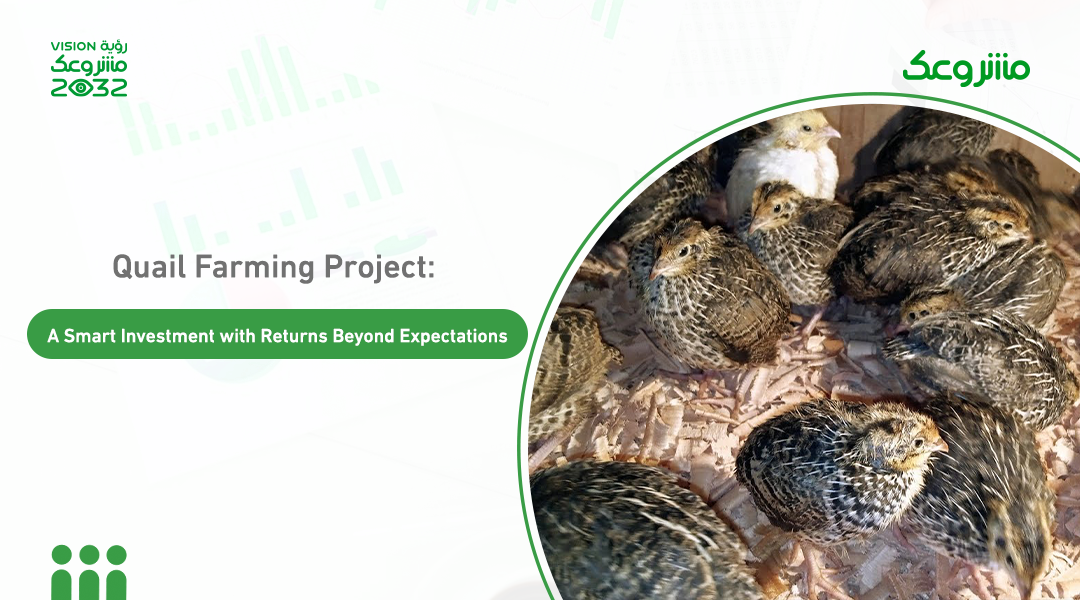
The quail farming project is considered a promising investment opportunity in the animal production sector due to its operational flexibility, low operating costs, and quick return on investment. In recent years, the demand for quail meat and eggs has increased because of their high nutritional value, distinctive taste, and health benefits, making them a preferred choice among consumers locally and internationally.
This project is attractive for investors because it can start with a relatively small capital and expand gradually according to market demand growth. It effectively contributes to food security, supports the agricultural economy, creates new job opportunities, and provides healthy products at competitive prices, combining economic viability with environmental and social sustainability.
Quail farming is an investment activity focused on producing quail meat and eggs for commercial purposes, leveraging the unique advantages of quails, such as a fast production cycle, lower feed costs compared to other poultry, and minimal space requirements. It is among the most profitable agricultural projects, as it can be implemented with limited resources and space while generating high returns in a short period.
The project’s success depends on careful planning, providing a suitable breeding environment with proper ventilation, temperature control, and hygiene, along with balanced nutrition and the latest veterinary and management practices to ensure high-quality production that meets local market needs and opens opportunities for export.
The quail sector is one of the most promising agricultural sectors in terms of investment returns due to the rapid growth in demand for its meat and eggs worldwide. In 2025, the global quail meat market was valued at approximately $500 million, with a projected annual growth rate of 7% from 2025 to 2033. The quail egg market was valued at $2.01 billion in 2024 and is expected to reach $2.88 billion by 2033, growing at a compound annual growth rate (CAGR) of 4.1%.
These indicators show that quail farming is not only profitable but also sustainable, especially with the continuous growth in global demand and diverse marketing channels, offering extensive investment opportunities for breeders and investors alike.
Provides a comprehensive overview of the project, its strategic objectives, required investment, expected financial returns, and capital recovery period. It highlights the competitive advantages, such as product quality, operational efficiency, and strategic location, along with growth opportunities in the local and regional markets.
This section covers the project’s definition, scope, and production nature, whether it is intended for quail egg production, fattening birds for meat sales, or both. It also includes determining the targeted production capacity, the number of annual production cycles, and the target customer segments. The proposed farm location, required area, and nature of the products are clarified, in addition to highlighting the project’s short- and long-term objectives, such as expansion or future product exports.
The market study is one of the most important elements of a feasibility study, as it determines the size of local and global demand for quail products and evaluates consumer trends, market prices, and current competitors. It also includes a detailed analysis of the target customer segments, such as restaurants, hotels, retail stores, and direct consumers. This study helps in identifying the expected market share and developing an effective marketing plan to ensure product distribution and profitability.
For more information on our market and competitor analysis service, click here
Covers the optimal quail farming system (cages or floor-based), production stages, required equipment, feed, water, energy consumption, and ensures operational efficiency and product quality.
Key Points on Which the Technical Feasibility Study of Projects is Based
Location & Area: Proximity to water sources, accessibility, distance from residential areas, and necessary infrastructure.
Equipment & Machinery: Cages, incubators, feeders, heaters, and cleaning tools.
Inputs & Suppliers: Feed, vaccines, initial birds, with reliable suppliers and contingency plans.
Management Structure: Roles and responsibilities, hiring, and training plans.
Legal Requirements: Permits, veterinary and agricultural licenses, health and safety certifications, and compliance with local regulations.
Environmental & Health Study: Waste management, disease prevention, and biosecurity measures.
Financial Analysis
Includes investment costs, operational costs, expected revenue, net profit, payback period, ROI, and sensitivity analysis.
Read Here: Everything About Financial Statement Analysis (Its Importance, Steps, and Types)
Risk Analysis & Mitigation
Identifies potential risks like diseases, price fluctuations, supply disruptions, and demand changes, with strategies for mitigation.
Read Here: Project Risk Management – What It Is, Its Importance, and How to Implement It
Implementation Plan & Timeline
Outlines the project phases, duration, performance indicators, and ensures timely completion and operational launch.
Summary & Recommendations
Provides a final assessment of feasibility, practical recommendations, opportunities for expansion, efficiency improvement, and adoption of new production technologies.
For more on the Quail Farming Project Feasibility Study Template, click here

To get in touch and request a feasibility study for a quail farming project
The kebab restaurant project is one of the food-service ventures that combines strong demand for grilled meals with the opportunity to target a diverse customer base, including individuals, families, and lovers of traditional Middle Eastern cuisine. With growing competition in the restaurant sector, however, the project’s success is no longer determined by food taste alone. […]
Read moreA children’s toy store project is not limited to selling toys; it is built on understanding what attracts children and what families look for when choosing products that combine entertainment and educational value. With the wide variety of educational toys, skill-development games, recreational toys, and gifts available, the store has opportunities to meet the needs […]
Read moreA residential complex project is no longer simply an investment in a collection of real estate units. It has evolved into an integrated development model that combines comfortable living, diverse services, and long-term investment value. As cities expand and residents’ needs evolve, demand is growing for residential complexes that offer a comprehensive environment suited to […]
Read moreThe veterinary clinic project comes at a time when animal care is no longer limited to treating illnesses or injuries, but has expanded to include health monitoring, vaccinations, routine checkups, and care for both pets and livestock. However, many animal owners face challenges in accessing specialized veterinary services that combine prompt response, high-quality care, and […]
Read more
خصم 25% على خدمات مشروعك استفد من العرض الآن، فالفرصة متاحة لفترة محدودة فقط
سجّل بياناتك واحصل على خصم 25% الآن


