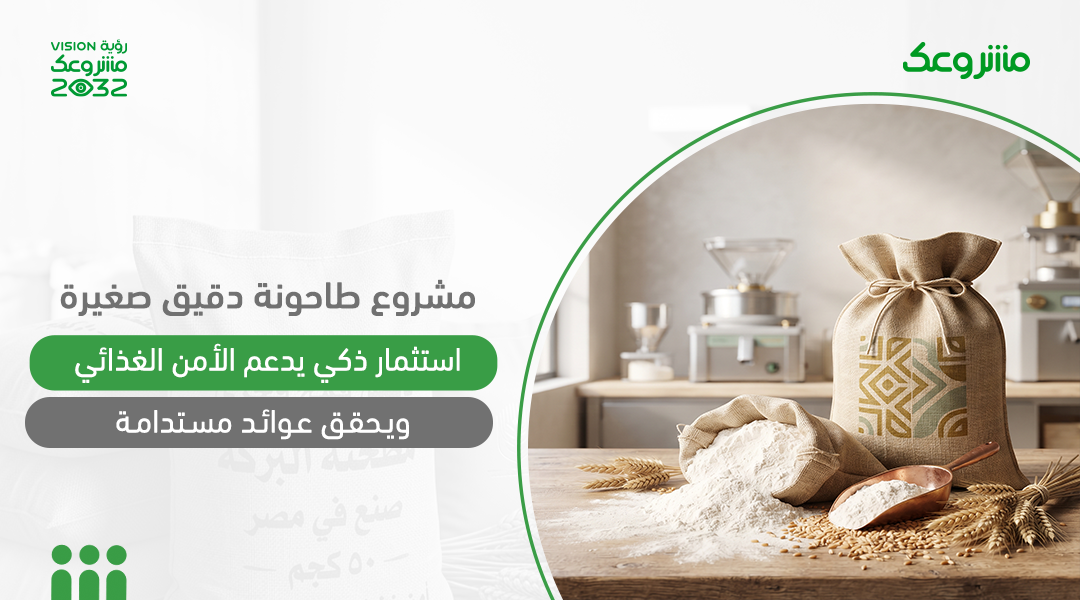
Small Flour Mill Project: A Smart Investment That Supports Food Security and Delivers Sustainable Returns - Mashroo3k
Published12 Aug 2026 0 comments 74 Observation
Small Flour Mill Project: A Smart Investment That Supports Food Security and Delivers Sustainable Returns

A small flour mill project is considered a promising industrial venture, given the essential role of flour in numerous food industries and the consistent demand for it from bakeries, restaurants, food manufacturers, and households. The project’s appeal extends beyond the stable demand for its products, as it also offers opportunities to increase production capacity and diversify product lines in response to market needs.
However, the success of the project depends on more than simply acquiring the necessary equipment and starting operations. It requires a thorough assessment of market demand and competition, selecting a suitable

What Is a Small Flour Mill Project?

A small flour mill project is an industrial venture designed to mill grains such as wheat, corn, and barley and process them into different types of flour using specialized equipment for milling, sifting, and packaging.
The project aims to meet the needs of bakeries, grocery stores, restaurants, food manufacturing facilities, and individual consumers, making it a business with consistent market demand. The success of a small flour mill project depends on sourcing high-quality raw materials, selecting equipment that matches the targeted production capacity, and applying strict quality standards throughout all stages of operation.

Is a Small Flour Mill Project Profitable?

Yes, statistical data indicates the strong economic potential of a small flour mill project.The global industrial flour milling market was valued at approximately USD 1.35 billion in 2024 and is expected to continue growing, reaching USD 2.49 billion by 2035, at a compound annual growth rate (CAGR) of 5.72% during the forecast period (2025–2035). This growth reflects stable demand and continued expansion opportunities within the sector.

Why Is a Small Flour Mill Project a Promising Investment Opportunity?

A small flour mill project is considered one of the most promising investment opportunities, as it offers several attractive investment advantages, including the following:

  • High demand for flour as an essential food commodity.
  • A diverse customer base, including bakeries, restaurants, hotels, and food manufacturing facilities.
  • The potential to generate stable revenues due to consistent demand for the product.
  • Flexibility to determine production capacity based on the available capital.
  • Ease of expansion by adding equipment or producing different types of flour.
  • Multiple revenue streams from primary and secondary milling products.
  • Supporting the food manufacturing sector by providing an essential raw material.
  • The potential to build a strong customer base through product quality and reliable supply.
  • Lower risk of declining demand compared with some other business ventures.
  • Enhancing competitiveness through high product quality and competitive pricing.

How to Start a Small Flour Mill Project

  • Conduct a comprehensive feasibility study to assess market demand, estimate expected costs, and calculate potential revenues and profits.
  • Select a suitable location that is easily accessible and provides sufficient space for equipment, storage, and operational activities.
  • Obtain the necessary licenses and permits to ensure that the project operates in compliance with applicable regulations and requirements.
  • Equip the facility with essential machinery, including milling machines, sifting machines, packaging equipment, and storage facilities.
  • Establish agreements with grain suppliers to ensure a reliable supply of high-quality raw materials at competitive prices.
  • Hire a qualified team with the necessary expertise to operate the equipment, monitor production, and maintain product quality.
  • Apply quality and safety standards throughout all stages of operation to ensure the production of flour that meets the required specifications.
  • Develop an effective marketing plan targeting bakeries, food manufacturers, wholesalers, and retailers, while building long-term customer relationships.
  • Continuously monitor performance and develop the project by controlling costs, improving productivity, and expanding the customer base.

Small Flour Mill Project Market Analysis

High demand for flour as an essential food commodity.
A diverse customer base, including bakeries, restaurants, hotels, and food manufacturing facilities.
The potential to generate stable revenues due to consistent demand for the product.
Flexibility to determine production capacity based on the available capital.
Ease of expansion by adding equipment or producing different types of flour.
Multiple revenue streams from primary and secondary milling products.
Supporting the food manufacturing sector by providing an essential raw material.
The potential to build a strong customer base through product quality and reliable supply.
Lower risk of declining demand compared with some other business ventures.
Enhancing competitiveness through high product quality and competitive pricing.

Read here: Market Research for a Project: The Foundation for Investment Planning and Selecting the Most Profitable Opportunities.

Small Flour Mill Project Cost and the Factors Affecting It

The cost of a small flour mill project varies from one project to another depending on several factors, the most important of which include:

  • Production capacity: The higher the production capacity, the greater the cost of machinery and equipment.
  • Type and quality of milling equipment: Prices vary depending on the technology used, equipment specifications, and brand.
  • Site preparation costs: These include construction work, finishing, electrical installations, and ventilation systems.
  • Raw material costs: Such as wheat, corn, or other grains used in the production process.
  • Labor and salaries: Costs vary according to the project size and the nature of its operational activities.
  • Licensing and permit costs: Expenses related to obtaining the licenses and permits required to operate the project legally.
  • Recurring operating expenses: Including electricity, water, maintenance, transportation, and packaging costs.
  • Marketing and distribution costs: Expenses required to reach target customers and build a stable customer base.

Read here: How to find profitable business ideas that match your budget?

Essential Equipment for a Small Flour Mill Project

  • Grain cleaning machine: Removes dust, dirt, and impurities from grains before the milling process begins.
  • Flour mill: The primary piece of equipment responsible for grinding grains and processing them into flour according to the required specifications.
  • Sifting and screening machine: Separates flour according to its fineness and removes any remaining impurities.
  • Grain storage silos or tanks: Store raw materials under suitable conditions before they are used in production.
  • Flour storage tanks or containers: Protect the finished product from moisture and contamination.
  • Flour filling and packaging machine: Packages the product in different weights, ready for sale and distribution.
  • Electronic weighing scale: Ensures accurate package weights before the products are distributed to the market.
  • Conveyor belts: Transport grains and flour between the different production stages quickly and efficiently.
  • Air compressor: Powers certain equipment and helps improve the efficiency of production lines.
  • Material handling and internal transportation equipment: Such as hand carts or small forklifts, to facilitate the movement of raw materials and finished products.
  • Safety and fire-fighting equipment: Ensures a safe working environment and protects employees and machinery.
  • Ventilation and dust collection systems: Maintain air quality within the production facility and reduce the spread of dust generated during milling operations.

Products Offered by a Small Flour Mill Project

  • White wheat flour: Used in the production of bread, pastries, and baked goods.
  • Whole wheat flour: Used in healthy, fiber-rich food products.
  • Corn flour: Used in food manufacturing and the production of certain baked goods and animal feed.
  • Barley flour: Used in the production of certain health foods and traditional products.
  • Bran: A by-product used in animal feed production and some food products.
  • Customized flour blends: Prepared according to the requirements of bakeries or food manufacturers, such as pastry and confectionery blends.
  • Packaged flour in various sizes: Designed to meet the needs of individuals, retail stores, bakeries, and wholesalers.

Operational Stages of a Small Flour Mill Project

  • Receiving and inspecting grains: Checking the quality of incoming grains and ensuring they are free from impurities or damage before entering the production line.
  • Grain cleaning: Using specialized equipment to remove dust, stones, and other foreign materials.
  • Milling: Grinding the grains using the flour mill to achieve the required level of fineness according to the type of product.
  • Flour sifting: Separating flour from bran and impurities and classifying it according to its fineness.
  • Product quality inspection: Ensuring that the flour meets the required specifications before packaging.
  • Filling and packaging: Packaging the flour in different weights and displaying the essential product information on each package.
  • Finished product storage: Storing finished products in suitable conditions that preserve flour quality until distribution.
  • Distribution and marketing: Supplying products to bakeries, grocery stores, wholesalers, and target customers in line with the marketing plan.

How to Ensure the Sustainability of a Small Flour Mill Project

To ensure the sustainability of a small flour mill project and achieve continuous growth, the project should focus on several key practices, including:

  • Diversifying products by producing different types of flour to meet the needs of various customer segments.
  • Expanding target markets by reaching new geographic areas and acquiring new customers.
  • Building a strong brand that enhances customer trust and increases product visibility in the market.
  • Upgrading equipment and technologies to keep pace with developments and improve production quality.
  • Reinvesting a portion of profits in increasing production capacity and developing the project.
  • Establishing long-term contracts with suppliers and customers to ensure stable supply and sales.
  • Monitoring market trends and analyzing customer needs to continuously improve products.
  • Adopting digital transformation in operations management, marketing, and performance analysis.
  • Implementing sustainable practices such as optimizing energy consumption and reducing production waste.
  • Developing a future expansion plan that includes adding production lines or entering new markets as demand increases.

Key Risks Facing a Small Flour Mill Project and Ways to Mitigate Them

RisksMitigation Measures
Rising grain and raw material pricesContract with multiple suppliers and purchase appropriate quantities when prices are stable.
Equipment and production line breakdownsConduct regular maintenance and keep essential spare parts available to minimize downtime.
Increasing market competitionOffer high-quality products, competitive prices, and excellent customer service.
Declining final product qualitySource high-quality raw materials and maintain quality standards throughout all stages of production.
Weak salesDevelop an effective marketing plan, expand the customer base, and diversify distribution channels.
Rising operating costsOptimize electricity and resource consumption and monitor expenses regularly.
Non-compliance with regulatory requirementsObtain all necessary licenses and comply with health, environmental, and safety regulations.
Damage to raw materials or products during storagePrepare suitable storage facilities and maintain proper storage conditions to preserve the quality of grains and flour.
Weak management and financial planningDevelop a clear operational plan and budget, and regularly review financial performance to support appropriate decision-making.

Read here: Risk management in projects: What is it, what is its importance, and how can it be implemented?

How to Choose the Right Location for a Small Flour Mill Project

Choosing the right location plays an important role in the success of a small flour mill project by facilitating production and distribution operations and reducing operating costs. The following criteria should be considered:

  • Proximity to raw material sources to reduce grain transportation costs and ensure a consistent supply.
  • Easy access to target customers, such as bakeries, food manufacturers, and wholesalers.
  • Sufficient space to accommodate equipment, production areas, storage facilities, and future expansion.
  • Availability of essential utilities, including electricity, water, drainage, and telecommunications services required for operations.
  • Easy truck access and movement to facilitate the delivery of raw materials and distribution of finished products.
  • Compliance with regulatory requirements and selecting a location that allows the necessary licenses to be obtained.
  • Avoiding densely populated residential areas in accordance with safety requirements and to minimize the impact of noise and dust.
  • Affordable rental or purchase costs that fit the project budget without compromising operational efficiency.
  • Availability of labor in the surrounding area to facilitate recruitment and reduce transportation costs.
  • Potential for future expansion by selecting a site that allows additional production lines or increased production capacity as the business grows.

My Experience with a Small Flour Mill Project

My experience with a small flour mill project began with a clear vision of a promising investment opportunity, particularly given the continued demand for flour as an essential product in the Egyptian market. However, moving from an initial idea to actual implementation revealed several challenges that were far from simple, starting with determining the appropriate production capacity and selecting the right equipment, followed by estimating costs, organizing operations, managing inventory, and securing the financing required to launch the project.

This is where working with the experts at Mashroo3k Consulting made a significant difference. The team supported me by preparing a comprehensive feasibility study covering the market, technical, and financial aspects, in addition to developing a clear framework for management and operations and mechanisms for controlling costs and resources. They also helped me prepare a complete financing file for submission to suitable financing institutions.

With this support, I was able to launch the project on a clearer and more organized foundation, improve operational efficiency, and gradually increase production capacity. This contributed to greater operational and financial stability and helped the project build a stronger customer base.

Frequently Asked Questions About a Small Flour Mill Project

How Much Do Flour Mills Cost?

The price of flour mills varies depending on production capacity, equipment type, level of automation, and country of manufacture. Therefore, there is no single standard price. Small mills are generally less expensive than large industrial production lines. Shipping, installation, and maintenance costs also affect the total investment. To obtain an accurate cost estimate, it is advisable to request quotations from several suppliers and select equipment that matches the project’s requirements and budget.

What Is the Difference Between Wheat Flour and Whole Wheat Flour?

The difference between wheat flour and whole wheat flour lies primarily in their processing methods and nutritional value. White wheat flour is produced by removing the bran and wheat germ, giving it a lighter color and finer texture, making it suitable for bread, pastries, and confectionery products.

Whole wheat flour, on the other hand, is milled from the entire wheat kernel without removing its components. As a result, it retains higher levels of fiber, vitamins, and minerals, making it a more nutrient-rich option commonly used in healthy baked goods and high-fiber products.

How Much Does Wheat Flour Cost in Egypt?

The price of wheat flour in Egypt varies depending on the type of flour, extraction rate, brand, and package size. It is also affected by fluctuations in wheat prices, as well as production and transportation costs.

Conclusion: Small Flour Mill Project

In conclusion, amid the continued growth of the food manufacturing sector, a small flour mill project stands out as a business with strong potential for success when planned professionally. Its success depends on understanding market needs, selecting the right equipment, and efficiently managing operations, in addition to preparing a comprehensive feasibility study that helps minimize risks and maximize return on investment.

Therefore, if you are looking to launch a successful and sustainable industrial venture, starting with a well-developed plan is the most important step toward achieving your objectives and transforming your business idea into a competitive and scalable project.

Contact us to request a feasibility study for a small flour mill project.


Similar Articles

How to Turn a Kebab Restaurant Project into a Distinctive Brand in Egypt?

The kebab restaurant project is one of the food-service ventures that combines strong demand for grilled meals with the opportunity to target a diverse customer base, including individuals, families, and lovers of traditional Middle Eastern cuisine. With growing competition in the restaurant sector, however, the project’s success is no longer determined by food taste alone. […]

Read more

Children’s Play Center Project in Saudi Arabia: How to Create an Experience That Attracts Children and Families?

A children’s toy store project is not limited to selling toys; it is built on understanding what attracts children and what families look for when choosing products that combine entertainment and educational value. With the wide variety of educational toys, skill-development games, recreational toys, and gifts available, the store has opportunities to meet the needs […]

Read more

Residential Complex Project in Saudi Arabia: An Investment That Creates Value Beyond Residential Units

A residential complex project is no longer simply an investment in a collection of real estate units. It has evolved into an integrated development model that combines comfortable living, diverse services, and long-term investment value. As cities expand and residents’ needs evolve, demand is growing for residential complexes that offer a comprehensive environment suited to […]

Read more

Veterinary Clinic Project in Egypt: A Promising Investment Opportunity in the Animal Care Sector

The veterinary clinic project comes at a time when animal care is no longer limited to treating illnesses or injuries, but has expanded to include health monitoring, vaccinations, routine checkups, and care for both pets and livestock. However, many animal owners face challenges in accessing specialized veterinary services that combine prompt response, high-quality care, and […]

Read more

Green Friday

فرصة لا تتكرر

GREEN FRIDAY

خصم 25% على خدمات مشروعك استفد من العرض الآن، فالفرصة متاحة لفترة محدودة فقط
سجّل بياناتك واحصل على خصم 25% الآن