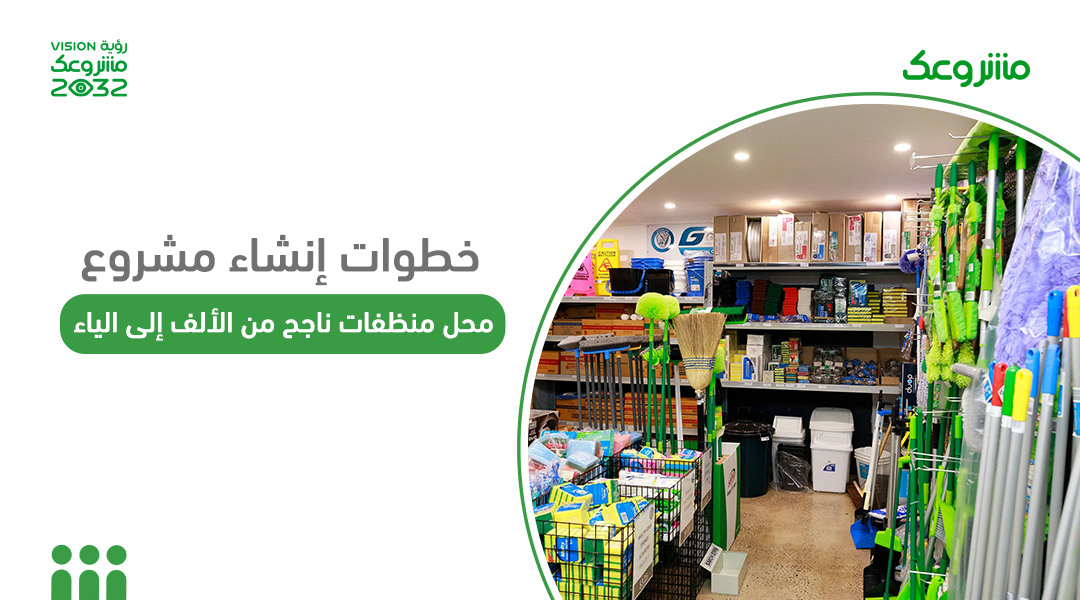
هذا النص هو مثال لنص يمكن أن يستبدل في نفس المساحة، لقد تم توليد هذا النص من مولد النص العربى، حيث يمكنك أن تولد مثل هذا النص أو العديد من النصوص الأخرى إضافة إلى زيادة عدد الحروف التى يولدها التطبيق.
A cleaning supplies store project is considered one of the most successful and stable small businesses, as it relies on a consumable product that is essential in every home and facility. With the growing awareness of public health importance, this project has become a promising investment opportunity for those seeking a stable and scalable return.
In this article, we provide a comprehensive guide to starting a cleaning supplies store project, including a precise definition of the business, an analysis of its profitability, and its competitive advantages. We also detail the cost components and step-by-step launch process. Additionally, we include a simplified feasibility study highlighting key performance indicators, and conclude with practical guidelines for careful planning and regulatory compliance to ensure the sustainability and success of your project in the market.
What is a Cleaning Supplies Store Project?
A cleaning supplies store project is a small business activity focused on providing essential daily-use cleaning products for establishments, such as liquid detergents, powders, disinfectants, and sanitizers, in addition to various cleaning tools. The project targets a wide range of customers, including individuals and households, as well as small establishments like offices, cafés, and retail shops that rely continuously on these products.
Is a Cleaning Supplies Store Profitable?
Yes, statistical indicators show that the global cleaning products market is experiencing strong and continuous growth. Its size was estimated at approximately $140.12 billion USD in 2025, expected to rise to $145.82 billion USD in 2026, and reach $178.06 billion USD by 2031, achieving a compound annual growth rate (CAGR) of around 4.07% between 2026 and 2031. These figures reflect strong demand and changing consumer behavior toward cleaning products, making a cleaning supplies store a profitable and sustainable business if managed properly.
Key Advantages of a Cleaning Supplies Store Project
Consistent year-round demand: Products are linked to daily household and commercial use.
Moderate initial capital: Requires a reasonable investment compared to many other business activities.
Good profit margin: Especially when purchasing in bulk or producing locally.
Wide product variety: Allows easy expansion of the customer base.
Easy storage: No complex technical equipment needed.
Flexible sales channels: Can sell both retail and wholesale, boosting overall revenue.
Scalable business model: Possibility to add new product lines or private brands.
Diverse target customers: Serves households, companies, and restaurants.
Fast cash cycle: High turnover of products ensures regular cash flow.
Effective marketing opportunities: Seasonal offers, bundles, and discounts can attract more customers.
Costs of Starting a Cleaning Supplies Store Project
The cost of establishing a cleaning supplies store varies depending on several key factors, including the store’s size, the range and variety of products offered, the location, and the level of equipment and setup required. Generally, the main cost components are as follows:
Store rent or site preparation: Securing a location suitable for the nature of the business.
Interior decoration and finishing: Enhancing the store’s appeal and product display organization.
Shelving, commercial furniture, and essential equipment: Necessary for smooth operations.
Initial inventory: Stocking cleaning products, disinfectants, sanitizers, and various cleaning tools.
Licensing and permits: Obtaining the commercial registration and paying required legal fees.
Marketing and advertising budget: To attract customers during the store’s launch phase.
Ongoing operational expenses: Covering utilities (electricity, water) and maintenance work.
Steps to Start a Cleaning Supplies Store Project
Prepare a detailed feasibility study covering marketing, financial, and operational aspects.
Analyze the local market to understand demand size, main competitors, and their strengths.
Identify the store’s competitive advantage—whether through pricing, quality, or product variety.
Choose a distinctive trade name that reflects the business identity and is easy to remember.
Select an appropriate store size that allows efficient product display and organization.
Ensure essential facilities such as electricity, water, and proper ventilation are available.
Obtain necessary licenses and commercial registration while complying with regulatory requirements.
Contract multiple suppliers to ensure stable supply and a variety of product options.
Implement a simple accounting system to accurately track sales and expenses.
Set a clear inventory management policy to avoid stockouts or overstocking.
Launch an initial marketing campaign to introduce the store and promote opening offers.
Create social media pages for ongoing promotion and customer engagement.
Build relationships with wholesale clients such as restaurants, companies, and institutions.
Monitor customer feedback and continuously improve service quality.
Review financial performance monthly to assess profitability and make development decisions.
Plan for future expansion by adding new products or opening additional branches.
Requirements for Opening a Cleaning Supplies Store in Saudi Arabia
All cleaning products must comply with the technical specifications outlined in the Technical Regulation for Detergents.
Dishwashing detergents must not exceed 0.29 grams of inorganic phosphorus, and laundry detergents must not exceed 0.49 grams.
Suppliers are required to fully cooperate with regulatory authorities and market inspection agencies by providing safety data sheets (SDS) and all technical documents upon request.
The ingredients of detergents must be listed on the safety data sheet using IUPAC-approved names and CAS numbers for each component, arranged in descending order by weight percentage, excluding non-essential impurities.
Detergent containers and packaging materials must be completely free of lead and heavy metals.
Plastic containers must carry the recycling symbol and should not affect the product or be affected by it during storage or use.
Detergents must be filled in secure, leak-proof containers, complying fully with packaging requirements specified in relevant standards.
Container capacity must be measured in SI units (or multiples/subunits) to ensure standard accuracy.
All detergent packaging must meet the technical and regulatory requirements specified in the applicable standards.
Label information on the container must be clear and comply with the technical requirements of the relevant standards.
Label information must adhere to GSO 1827, the standard for industrial product labeling.
No images, phrases, or content on the packaging may violate public order, public morals, or prevailing Islamic values in Saudi Arabia.
For more information on the requirements for opening a cleaning supplies store in Saudi Arabia, click here.
Factors for Success and Sustainability of a Cleaning Supplies Store
Choose a strategic and accessible location close to densely populated residential areas, with good visibility and easy access.
Offer a wide and diverse range of detergents and cleaning tools to meet customer needs.
Ensure product quality and compliance with standard specifications.
Adopt competitive pricing with periodic promotions and discounts to attract customers.
Provide excellent customer service, responding quickly to complaints and inquiries.
Build strong relationships with suppliers to ensure consistent product availability and stable prices.
Manage inventory efficiently to avoid stock shortages or overstocking.
Run ongoing marketing campaigns through social media and local advertisements.
Innovate by introducing new products or additional services, such as home delivery or wholesale supply.
Monitor market trends and consumer behavior to adapt the store offerings to changing needs.
Comply with health, safety, and technical regulations to ensure uninterrupted operation.
Invest in customer loyalty programs to encourage repeat purchases and expand the base of regular clients.
Frequently Asked Questions about a Cleaning Supplies Store
What cleaning tools are commonly used? Cleaning tools are essential supplies for homes and businesses of all types. They include:
Brooms (manual, electric, and other types)
Mops and cleaning buckets
Brushes of various shapes and sizes
Cleaning cloths and pads made from different materials
Protective gloves and safety tools
Glass and surface cleaning tools designed for high efficiency
Including these tools in the store’s offerings is a strategic addition that enhances product variety and completes the customer experience when purchasing detergents, increasing average order value and customer loyalty.
Is a cleaning supplies store profitable? Yes. Selling cleaning supplies is relatively high in economic feasibility because it relies on essential daily-use products for homes and businesses. Profitability is supported by several strategic factors:
Repeat purchases from the same customer segments
Product variety, from liquids and powders to cleaning tools
Ease of local marketing and lower entry barriers compared to other sectors
With effective management, a focus on product quality, and customer satisfaction, this type of business can generate a stable and scalable financial return.
Procedures for Licensing a Cleaning Supplies Store
The official procedures for opening a cleaning supplies store vary from country to country, but they generally revolve around several key steps:
Choosing a compliant location – the site must meet municipal and regulatory requirements.
Obtaining a valid commercial registration – this establishes the business legally.
Securing an activity license – issued by the competent authority, allowing the sale of cleaning products.
Complying with safety and hygiene standards – essential for handling and selling consumer products.
Registering with government or regulatory bodies – as required by local laws, to ensure oversight and legal compliance.
Cost of Establishing a Cleaning Supplies Store
The cost of starting a cleaning supplies store depends on several main factors:
Store size and location – high-traffic or central areas generally cost more.
Type of products offered – branded versus locally manufactured items.
Operational model – whether it’s retail only, wholesale, or includes delivery services.
Main cost components typically include:
Store setup: interior décor, shelving, and electrical fixtures.
Initial inventory: detergents, disinfectants, sanitizers, and cleaning tools.
Licenses and official approvals.
Initial operating expenses: utilities (electricity, water) and marketing.
Because of these variables, there is no fixed cost for this type of project. Expenses vary significantly depending on local conditions and the operational requirements of each investor.
In conclusion of our article on a cleaning supplies store project
It becomes clear that a cleaning supplies store is a successful project that combines operational stability with ease of management, provided it is built on careful planning and a solid foundation. Understanding the nature of the business, assessing its profitability, realistically estimating costs, and fully complying with regulatory and health requirements are essential pillars that enable the investor to make a well-informed and deliberate investment decision. Therefore, if you are looking for a practical business idea tied to continuous daily needs, offering operational flexibility and clear growth potential, a cleaning supplies store could be an ideal starting point for your investment journey—especially when supported by a strategic vision and a commitment to quality and service standards.
Get in touch with Mashroo3k and request a feasibility study for a cleaning supplies store
The kebab restaurant project is one of the food-service ventures that combines strong demand for grilled meals with the opportunity to target a diverse customer base, including individuals, families, and lovers of traditional Middle Eastern cuisine. With growing competition in the restaurant sector, however, the project’s success is no longer determined by food taste alone. […]
A children’s toy store project is not limited to selling toys; it is built on understanding what attracts children and what families look for when choosing products that combine entertainment and educational value. With the wide variety of educational toys, skill-development games, recreational toys, and gifts available, the store has opportunities to meet the needs […]
A residential complex project is no longer simply an investment in a collection of real estate units. It has evolved into an integrated development model that combines comfortable living, diverse services, and long-term investment value. As cities expand and residents’ needs evolve, demand is growing for residential complexes that offer a comprehensive environment suited to […]
The veterinary clinic project comes at a time when animal care is no longer limited to treating illnesses or injuries, but has expanded to include health monitoring, vaccinations, routine checkups, and care for both pets and livestock. However, many animal owners face challenges in accessing specialized veterinary services that combine prompt response, high-quality care, and […]